Appendix B — The COST Ledger: Theorems, Proofs, and Falsification Harnesses
Staging tier [B]. This appendix carries the statements and proof status of the COST-face theorems (Paper III).
What [proved] requires. Under the charter’s theorem-custody rule (T-CUST-1), a
theorem reaches [proved] only when it ships four things:
1. a written proof;
2. an R-IND-5 fresh-context adversarial pass;
3. a committed C3 numerical falsification harness, built to fail if the theorem is false;
4. a constants/slack and known-gaps table.
A green harness is a net, not a proof (T-CUST-2). Full proofs live in Paper III and its appendix. This ledger gives each statement, its status, its custody, and the verification incidents it survived.
Status as of 2026-11-21. A custody pass (VI-32, claims/audits/VI-32-PaperIII-B.md)
found, and later passes (VI-34, VI-36 to VI-38) extended, that this appendix had overstated
itself:
- no theorem here had a custody table, so none was [proved];
- three of its statements misstated Paper III (B1, B4, B6);
- one constant was wrong (B7, NEG-18);
- some of the harnesses could not fail.
The classes below are corrected to the ledger, which wins (Appendix F). A theorem whose
statement is netted by a sealed C3 registration is [predicted]-grade until its custody
table exists.
[proved] since 2026-11-21. Ledger row PAPER-III.a, with its custody file
claims/custody/PAPER-III.a.md, covers lem:maxdet’s single-letter rate identity and the max-det
corner identity of B4 and B5: the max-det closed form (derived in lem:maxdet since 2026-11-21,
read by VI-47) and the rate-loss corner step. Their coding readings keep the classes given below.
B7’s corrected variance formula is row PAPER-III.b, [proved] since the rate identity it rests on
was netted (verify_paper3_rate_identity.py, 2026-11-21). Reading it as the dispersion stays
[exploratory] (VI-48).
Conventions
- Source $x$ with covariance $\Sigma_x$.
- Observer read metric $P$ (dropping the subscript $C$).
- Coding error $\delta$, with covariance $\Sigma_\delta$.
- Read distortion $D = \operatorname{tr}(P\Sigma_\delta)$.
- The whitened basis is $\Sigma_x^{1/2} P \Sigma_x^{1/2}$. Several constants are correct only in this basis, the recurring lesson of VI-4 and VI-6.
Thm B1 — Consumer rate–distortion achievability & converse
Statement. For a Gaussian source and read metric $P$, the minimum rate to achieve read
distortion $D$ is $R_C(D)$. It is achieved by a test channel that does reverse
water-filling in the whitened basis, on the tilted source $Y = P^{1/2}X$ (Paper III
prop:rd, lem:tilt, thm:coding, cor:coding).
(Paper III’s own thm:B1 is a different result: the coding theorem for the true
divergence. An earlier sentence here, “the reduction in true divergence … is the tilt”,
matched no statement and is withdrawn.)
Status.
- R-IND-5: VI-3.
- The single-letter Gaussian identity behind it, lem:maxdet’s rate identity, is
[proved] (ledger row PAPER-III.a) since 2026-11-21. thm:coding, the operational theorem,
still has no net.
- thm:coding has no C3 net of its own; verify_appendixB.py nets thm:B2/cor:B2a and
part of thm:B3.
- [exploratory] pending a net and custody.
Custody / gaps. - Verbatim Kostina–Verdú transfer holds for the fixed-$P$ Gaussian case. - The true nonlinear consumer keeps its “should port” hedge. - Constants hold in the whitened basis only.
Thm B2 — Output ≤ surrogate ≤ reconstruction at matched rate
Statement. At matched rate, coding for the consumer’s output metric is no worse than
coding for a surrogate read metric, which is no worse than coding for reconstruction, on
the consumer metric. This is Paper III’s registered prediction GO-6, not its thm:B2,
which is the output-reduction theorem.
Status. [demonstrated] by the ledger, and disputed (VI-32, VI-34): the findings below
mean the harness does not test the claim’s matched-rate premise. A re-run at matched rate is
owed, and the class is the author’s to set. What GO-6 (GO-P-2026-028) measured:
- the ordering holds at every rate tested;
- reconstruction is up to about 500× worse at high rate;
- the median gap is $+2.45$;
- the isotropic control collapses the three coders.
What VI-32 found: - No theorem gives the ordering, the “kernel entropy share” (which is undefined) or the rate dependence, so the earlier “the analytic statement is proved” is withdrawn. - The harness charges (b) and (c) a backward-channel rate while measuring their distortion with forward noise, so the rates are not exactly matched. - The harness’s isotropic control assigns all three curves the same array.
Thm B3 — The surrogate–output gap vanishes with rate
Statement. The relative gap $(b - a)/(c - a)$ between a surrogate-optimal and an
output-optimal code shrinks to zero as the rate grows (GO-6 (iii)). Paper III’s thm:B3 is
the high-resolution formula, a different statement.
Status. [demonstrated] by the ledger, and disputed with B2, since it uses the same
harness: GO-6 measures the gap falling from $0.41$ to $0.005$. There is
no analytic theorem; VI-3 graded the high-resolution argument PLAUSIBLE-with-conditions.
Its Linder–Zamir conditions are cited, not checked, and the formula also needs
$\mathbb E\log\det G<\infty$.
Consequence. At high resolution a surrogate for $P$ suffices; at low resolution it does not. This is why the blind probe (Chapter 10) is load-bearing precisely in the bit-starved regime.
Thm B4 — Two-observer region & refinability
Statement. The achievable rate region for two observers $(P_1, P_2)$ is contained in
the max-determinant region of Paper III (thm:region), with
$0\prec\Sigma_f\preceq\Sigma_b\preceq\Sigma_x$, and equals it under Assumption SR.
If a single scalable code serves both observers at their single-stage optimal rates
$R_1(D_1)$ and $R_2(D_2)$ (the corner), the coarse observer with a prefix of the fine
observer’s bits, then the observers’ optimal error covariances nest,
$\Sigma_2^\star\preceq\Sigma_1^\star$ (thm:multiobs); under Assumption SR nesting also
suffices. (Without the corner rates the statement is false: Paper III’s sec:multiobs, consequence
(iii), is served by two independent codes at a higher total rate; VI-39, VI-40.) This condition depends on $D_1$
and $D_2$.
Non-nested optima incur at least the rate loss of thm:multiobs-loss, and exactly that loss
under Assumption SR. (Stated unconditionally until 2026-11-21; VI-38.)
Correction (VI-32). This appendix used to state the criterion as “iff $P_1\preceq P_2$”. That is false in both directions: - not refinable although $P_1\preceq P_2$: $\Sigma_x=I_2$, $P_1=\mathrm{diag}(1,0)$, $P_2=I$, $D_1=0.5$, $D_2=1.2$; - refinable although $P_1\not\preceq P_2$: $P_1=2I$, $P_2=I$, $D_1=1$, $D_2=0.2$.
The paper always had it right.
Status.
- Proof plus R-IND-5 (VI-4; later VI-32, VI-36 to VI-40, VI-46 and VI-47).
- Sealed net 022, but that net is weak. VI-32 re-inserted VI-4’s original bug into
verify_two_observer.py, and checks [1]–[3] still pass. Only verify_rate_region.py [3]
catches it.
- Split (VI-36, corrected by VI-37). verify_rate_region.py [3] computes the
closed-form Gaussian corner and takes the region as given, so what it nets is the
max-det corner identity (the closed forms of $\Sigma^\star$, $\Sigma^\circ$ and $L$):
[proved] since 2026-11-21 (ledger row PAPER-III.a, netted by verify_paper3_nets.py
m1–m4 in CI; it was [predicted]-grade pending custody). The coding statements take the
region’s class:
the necessity of nesting and the rate loss as a lower bound rest on the region converse,
which has no net that can fail, and the sufficiency of nesting and the attained minimum
rest on Assumption SR (achievability, attributed to Effros, unchecked): [exploratory].
verify_paper3_nets.py nets the closed forms and the corner restriction; it too takes the
region as given.
Verification incident (VI-4, standing).
- The bug. An in-context sigma_star formula used
$(\Sigma^\star)^{-1} = \Sigma_x^{-1} + \lambda P$, with the inline claim “the cap never
binds”.
- The catch. A fresh-context adversarial pass found that the max-det error covariance is
reverse water-filling in the whitened basis, and that the cap does bind on $\ker P$.
- The fix. The formula was corrected and the harness re-run. The analytic theorem
statement was unaffected; the harness was wrong.
- Later (VI-32). The “decisive” check added then is an algebraic identity that holds for
any nested pair, so it cannot detect the bug.
Thm B5 — Rate region & the $k$-observer chain
Statement.
- Converse and the necessity of nesting: for $k$ observers in a chain, the achievable
region is contained in the chain of nested max-det covariances (cor:kobs, with
$0\prec\Sigma_k$), and refinability implies that the single-stage optima nest. Paper III
proves both, with the $n$-block step added in 2026-11.
- Under Assumption SR, for every $k$ (for $k=2$: thm:region, thm:multiobs), the
region equals that set and refinability is equivalent to nesting.
- Achievability, for every $k$, and with it the sufficiency of nesting: the
independent-Fisher-increment Gaussian test channel realizes every feasible chain, but
turning it into codes is not proved in Paper III. That step is Paper III’s Assumption SR,
attributed to Effros (IEEE T-IT 1999), which Kostina–Tuncel cite for the two-stage region
on continuous alphabets; that it covers $k\ge3$ stages is a reading of its title
(“multiresolution”), and its hypotheses for this Gaussian case are still to be checked at
the source. Every achievability claim
here, for $k=2$ too, rests on it. (Checked 2026-11-21, VI-36: Kostina–Tuncel, which Paper III
cited as the coding theorem, is a two-stage parametric characterization of the region’s
boundary, and itself cites Effros for the continuous-alphabet extension.)
Status.
- $k=2$, the max-det corner identity: proof, R-IND-5 (VI-5), and the sealed net 023, whose
check [3] is a real net for it. [proved] since 2026-11-21 (ledger row PAPER-III.a,
netted in CI by verify_paper3_nets.py). Refinability as a coding statement is
[exploratory], as in B4.
- The region converse: proof and R-IND-5, but no net that can fail. 023’s [1] is an
identity, and [2] cannot fail on the region’s coupling. [exploratory] until a net
exists.
- Achievability, for $k=2$ as for $k\ge3$: Assumption SR, unchecked (FRONTIER G12b).
Verification incident (VI-5). One error was caught before publication, (b) below. A citation was also flagged, but VI-5’s replacement readings proved unchecked or wrong (VI-36 to VI-40), so (a) is not counted as a catch: - (a) the citation: Rimoldi’s is the finite-alphabet $L$-stage result (VI-5’s reading; Kostina–Tuncel quote it for two stages, and the $L$-stage form is not checked at the source; VI-39); - (b) the two-stage K-map does not iterate: an accumulating rotation ambiguity leaks Fisher information by $O(0.1)$ per stage.
Achievability was restated with independent increments. VI-32 found that the follow-on claim, that the two-stage arguments “extend verbatim”, was itself unproved. It is now withdrawn in Paper III.
Thm B6 — The price of a misidentified observer: tax and floor
Statement (tax). Suppose the coder’s metric $\hat P$ and the consumer’s $P$ satisfy
$m\hat P\preceq P\preceq M\hat P$ on their shared range (equal ranges, Loewner constants
$0<m\le M$). Then the design built for $\hat P$, $\Sigma^\star(\hat P,D/M)$, meets the
consumer’s distortion $D$ at an excess rate of at most $(r/2)\log(M/m)$, in the coding
regime the theorem states, and the $r/2$ is sharp (thm:commission, which gives the exact
design and regime).
(This appendix used to say “a rank-$M$ read metric when the consumer’s is rank $m<M$”, which confuses the Loewner constants with ranks; VI-32.)
Statement (floor). Every allocation in the $\hat P$-water-filling family, when $\hat P$
omits a direction the consumer reads, hits a distortion floor
$D \ge D_{\text{floor}} = \operatorname{tr}(\tilde P\Pi)$, with the whitened kernel.
The achievable band is the compact $[D_{\text{floor}}, \operatorname{tr}(P\Sigma_x)]$: a
floor, not unbounded distortion (thm:omission).
Status.
- Proof plus R-IND-5 (VI-6), and the sealed net 024. Its commission bound is a real check;
its omission “alt” floor is a tautology.
- [predicted]-grade, pending custody.
- The floor is also [demonstrated] downstream on a trained model: GO-P-2026-027,
held-out layers {4,20}, floor 16/16, asymptotic ratio 800–5700×.
Verification incident (VI-6). Two corrections were made before publication: - omission gives a floor, not unbounded distortion; - the floor uses the whitened kernel. A naive kernel projector overstates it by about 30% when $\Sigma_x \ne I$.
The 0.647 Llama overlap is a conditional certificate. It holds given omission, equal weights and an isotropic source ($\Sigma_x=I$). VI-32 restored the isotropy condition, VI-6’s own lesson.
Related negative (NEG-13 → resolved). The first sealed finite-rate gate for the floor missed (0/16), a shallow-sweep artifact that conflated “floor reached” with “floor exists”. It was resolved by a fresh held-out test, not by relaxing the bar (Chapters 15–16).
Thm B7 — Dispersion counts at most the read dimensions
Statement. The finite-blocklength consumer coding problem is the $r$-dimensional
tilted problem at every blocklength (prop:dispersion, by a covering argument). For the
Gaussian quadratic case its dispersion is
$$V_Y(D)=\tfrac12\Bigl[r_D+\sum_{k:\,0<\gamma_k\le\theta}(\gamma_k/\theta)^2\Bigr]\ \text{nats}^2,\qquad r_D\le 2V_Y\le r,$$
with $\gamma_k$ the tilted mode variances, $\theta$ the water level, and $r_D$ the active
modes (cor:dispersion). Equality holds on the right iff $\gamma_k\ge\theta$ for every
$k$, which covers the whole low-distortion regime. It counts at most the $r$ read
dimensions, never the ambient $d$. (A first correction wrote “$<r$”, which fails when
every mode is active.)
Correction (NEG-18, VI-32). This appendix, Paper III and prereg 025 gave the dispersion as $(r_D/2)\log^2e$, counting only the active modes. The value came from VI-7’s “sharpening”. Modes below the water level contribute too, because fluctuations of their energy are absorbed by the active modes. A Monte Carlo at $\gamma=(4,2,0.6,0.3)$, $\theta=1$ gives a variance of 1.226 against the claimed 1.0. The bound survives.
Status.
- The finite-$n$ reduction: proof plus R-IND-5 (VI-7), and the sealed net 025. But 025’s
checks C4 and D1–D3 are tautological and C3/C3b are circular, so none of them can fail:
[exploratory] until a net exists (VI-34).
- The dispersion formula: [refuted] as earlier stated. The corrected variance was
re-derived by two fresh contexts (VI-34, VI-36) and is netted by verify_paper3_nets.py
(m5, m6), in CI since 2026-11-21. The corrected formula is [proved] (ledger row
PAPER-III.b, custody file claims/custody/PAPER-III.b.md) as the variance of the tilted
information. It rests on lem:maxdet’s rate identity, which VI-46 found unnetted and
verify_paper3_rate_identity.py now nets. Reading it as the consumer problem’s dispersion
also needs the finite-$n$ reduction above, which stays [exploratory], and kernel uniqueness,
which is proved but on which no check can fail (VI-48). Identifying the variance with the dispersion is Kostina–Verdú’s
Thm 12, checked at the source on 2026-11-21 and independently by VI-38: it holds for
abstract alphabets, and its restrictions (i)–(iv) and basic conditions (a)–(c) hold for
the vector letter (cor:dispersion). VI-37 checked the uniqueness argument line by line
and VI-38 found it right; VI-38 corrected restriction (iv): it is $\mathbb E[d^9]<\infty$, not the third moment the
assistant had read and used to overrule VI-37’s verifier.
- 025’s check C3b is circular and samples only the all-active regime. The net with
inactive modes is now verify_paper3_nets.py (m5, m6), in CI since 2026-11-21.
- The scalar constant $\tfrac12\log^2e$ is Kostina–Verdú’s eq. (94), for
$0<d<\sigma^2$ (checked at the source, 2026-11-21; FRONTIER G12 closed).
Verification incident (VI-7). A draft claimed the finite-$n$ equivalence was “exact at every $n$ because the tilt is a bijection”, with “effective dimension $= r$”. The fresh-context pass found that the equivalence rests on a covering argument. Its replacement, “effective dimension $r_D$”, was itself wrong for the dispersion (NEG-18).
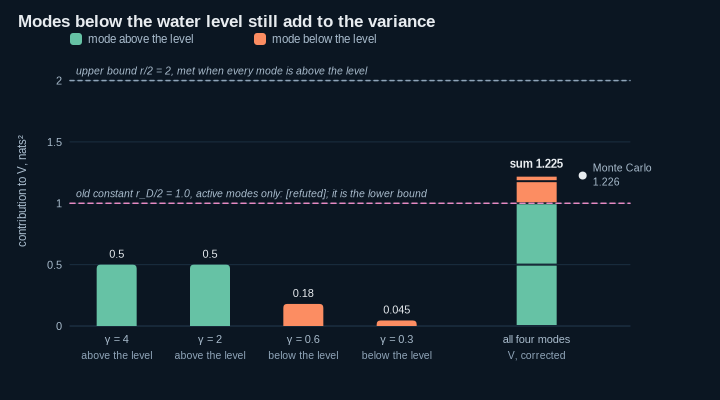
Figure B.1. The corrected variance of Theorem B7 on the appendix’s test case, tilted mode variances (4, 2, 0.6, 0.3) and water level 1, in nats squared. Each mode above the level contributes 1/2. Each mode below it contributes (γ/θ)²/2, here 0.18 and 0.045, which the old constant left out. The sum is 1.225; the Monte Carlo of the definition quoted in the text gives 1.226. The old constant r_D/2 = 1.0, counting active modes only, is [refuted] (NEG-18) and is drawn as a dashed line; it survives as the lower bound, and the upper bound is r/2 = 2. The corrected formula is [proved] as the variance of the tilted information (ledger row PAPER-III.b); reading it as the dispersion stays [exploratory].
Custody summary (corrected 2026-11-20 and 2026-11-21)
| Thm | Statement grade | Harness (C3) | Prereg | Incidents | Class |
|---|---|---|---|---|---|
| B1 | proof + R-IND-5 | none for thm:coding |
022 blk | VI-3, VI-32, VI-38 | [exploratory] (pending net + custody) |
| B2 | — (registered prediction GO-6) | GO-6 (rates not exactly matched) | 028 | VI-32, VI-34 | [demonstrated], disputed; re-run owed |
| B3 | PLAUSIBLE-w/-cond. (high-res.) | GO-6 | 028 | VI-3, VI-32, VI-34 | [demonstrated], disputed; re-run owed |
| B4 | proof + R-IND-5 | 022 (weak: misses VI-4’s bug); verify_rate_region [3]; verify_paper3_nets m1–m4 |
022, 023 | VI-4, VI-32, VI-36, VI-37, VI-38, VI-39, VI-40, VI-42, VI-45, VI-46, VI-47 | max-det corner identity [proved] (PAPER-III.a); region, refinability and rate loss as coding statements [exploratory] |
| B5 | proof (converse, $k=2$) + R-IND-5 | verify_rate_region [3] (the corner only) |
023 | VI-5, VI-32, VI-34, VI-37, VI-38, VI-39, VI-40 | corner identity [proved] (PAPER-III.a); region [exploratory] (converse unnetted; achievability under Assumption SR, unchecked, every $k$) |
| B6 | proof + R-IND-5 + measured floor | 024 + 027 | 024/026/027 | VI-6, NEG-13, VI-32, VI-38 | [predicted]-grade; floor [demonstrated] |
| B7 | reduction: proof + R-IND-5 | 025 (no check can fail); verify_paper3_nets m5–m6 (variance) |
025 | VI-7, NEG-18, VI-34, VI-36, VI-37, VI-38, VI-45, VI-46, VI-48, VI-49 | reduction [exploratory]; corrected $V$ as a variance [proved] (PAPER-III.b), as the dispersion [exploratory]; old constant [refuted] |
Two ledger rows are [proved] (2026-11-21). PAPER-III.a covers the max-det corner identity of B4
and B5 and lem:maxdet’s rate identity; PAPER-III.b covers B7’s corrected $V$ as a variance. Their custody
files are in claims/custody/. No other row
here has a custody table yet.
The appendix used to end on “the discipline caught the errors, and the record shows where”. That stays true, with a correction. The first round of passes caught four errors in seven derivations. A second round, four months later, found that one of the fixes (VI-7’s) was itself an error, and that one net (VI-4’s) could not detect the bug it was built around. The discipline works only if the fixes are checked too.