Chapter 8 — VALUE: What Preserving the Read Buys
The COST chapter priced the read. This one shows what you buy: at a matched bit budget, a code that preserves what the consumer reads beats a genuinely reconstruction-optimal code on the consumer’s task — while the reconstruction-optimal code reconstructs the signal better. The two facts are simultaneous, and their simultaneity is the point. We call it the flip, and it is the empirical heart of the book.
The claim, stated to be falsifiable
Fix a budget. Build two codes for the same source: an R-arm that preserves the read metric (small $\operatorname{tr}(P_C\Sigma_\delta)$) and an O-arm that is reconstruction-optimal (small $\operatorname{tr}(\Sigma_\delta)$). The flip is the conjunction of two sealed inequalities:
- Downstream (the flip proper): the R-arm beats the O-arm on the consumer’s task.
- Reconstruction (the trade): the O-arm reconstructs the source better than the R-arm.
Either alone is unremarkable. Together they are a dissociation: the code that is worse by the universal yardstick is better by the only one that ships. A third, control arm — the anti-arm, which deliberately destroys the read direction — must be worst downstream, or the read operator is not what governs the task. A row counts as a flip only when all of these hold on held-out data at matched bits; a one-metric family recommendation from the proxy probe is a weaker thing, an (A2) verdict, and the book keeps the two labels distinct (see Caveats, below).
This is a strong claim and a fragile one — fragile by design, because a claim that cannot fail cannot inform. So the program did the one thing that makes such a claim worth anything: it sealed the prediction before each measurement, wrote the pass/fail bar in advance, and published the misses.
The dissociation, cleanly (GO-2)
The cleanest laboratory instance is on transformer KV-keys. At audit-matched bits, a reconstruction-identical pair of arms (recon 0.0934 vs 0.0938) differs 2.53× downstream (12/12), with the anti-probe 21× worse [demonstrated — GO-P-2026-002]. Because the reconstruction is held essentially equal, the downstream difference cannot be a reconstruction effect; it is the read metric doing the work. The positive half — that the controlling quantity is $\operatorname{tr}(P_C\Sigma_\delta)$ — then replicated on a second representation and consumer: softmax attention (GO-P-2026-006, symmetric flip, proj-var tracks 12/12, recon blind) and, prospectively, embedding retrieval at identical recon 0.0964 (GO-P-2026-009, read-A adv $-4.70$ / read-B $+4.65$, 12/12 both) [replicated]. Two representations, two consumers, one mechanism. The path to it ran through refuted proxies (NEG-5…10), which is the subject of Chapter 16; the point here is that the endpoint is a clean, twice-instantiated dissociation.
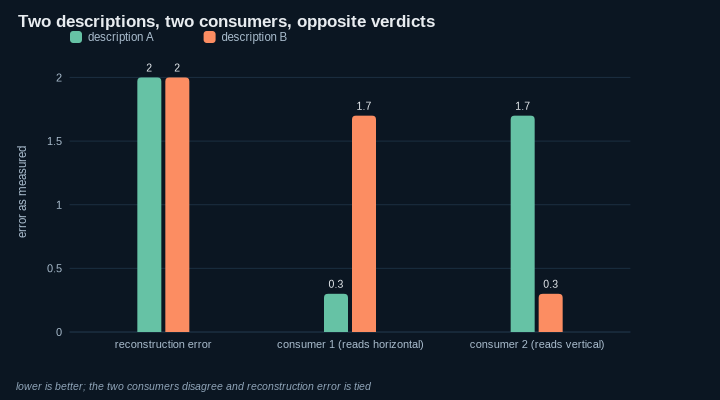
Figure 8.1. The flip in its smallest form. Descriptions A and B are the two errors of Figure 5.1, with equal reconstruction error 2. A consumer that reads the horizontal direction ranks A first (0.3 against 1.7). A consumer that reads the vertical direction ranks B first. Reconstruction error cannot rank them at all. This is an illustration of the mechanism, not a measurement; the measured cases are in the text.
The flip is a property of observation, not of a domain
If the flip were an artifact of the regimes it was first shown in, it would not travel. It travels. The domain-generality sweep (Chapter 13 gives the full table) put it at risk in twelve domains and three distinct branches of physics, each config-frozen on a calibration split and scored on held-out data, outcomes reported regardless of sign. The headline confirmations:
- Acoustic (D2, AV16.3): a second, fully independent microphone corpus — different array (8-mic circular), room, speakers, camera-tracked 3D-mouth ground truth. Clean flip 148/201 (74%), recon-trade 201/201, anti 152/201, against absolute tracked GT [predicted, hit — GO-P-2026-034 D2].
- Seismic (D3, PDAR): a third distinct physics — elastic waves from real M≥6.5 earthquakes, read by a 13-element IMS array, scored against the USGS catalogue backazimuth. Flip 13/17 (76%), recon-trade 17/17, anti 13/17 [predicted, hit — GO-P-2026-034 D3]. A quantizer that reconstructs the seismogram better points at the wrong epicenter.
- Cetacean (whale, 038): sperm-whale coda dialect, a clan classifier consumer, 8718 codas of inter-click-interval rhythm. Held-out read-preserving AUROC 0.934 vs reconstruction-optimal 0.883, recon-trade (O reconstructs 2× better yet downstream worse), flip 300/300 [predicted, hit — GO-P-2026-038, promoted from an earlier (A2) verdict to a sealed flip].
- Legal (036/039): citation-ranking on a real large corpus (CourtListener, LaBSE), the read operator recovered blind from the consumer. On a fully virgin opinion-disjoint split, R=0.796 > O=0.780 downstream, recon O=0.223 ≤ R=0.561, flip 200/200 [predicted, hit — GO-P-2026-039].
Synthetic ULA (031) and real acoustic LOCATA (033) are two further confirmed anchors. The LLM attention rematch (021) is a weaker result of its own kind: reconstruction-invisible worse-arm discrimination on one consumer, not a flip. Across anchors and confirmations the flip spans ≥5 independent domains and ≥3 distinct physics (synthetic, acoustic, seismic; the electromagnetic radar row, D1, is partial) plus non-physical consumers (a dialect classifier, citation retrieval). The battery’s own sealed prediction — flip in ≥2 of the 3 core prospective domains — was met by D2 and D3 [predicted → met].
Why it works: whitening and the read subspace
Mechanistically, the R-arm wins because it spends its bits in the read subspace and
the O-arm spreads them to be small on average, depositing error where the consumer
looks. The best single code the program found is the ZCA-whitened code, which
decorrelates the source before allocating bits and thereby aligns the code’s error
covariance with the read metric’s geometry; on whale codas it wins at every bit level
(0.83/0.85/0.97 vs per-channel 0.41/0.80/0.89) [exploratory — an a2_probe
characterization, not a sealed test]. But no single code wins
everywhere, and that is not a gap — it is the regime structure of Chapter 12. Whitening
wins where the source is cross-channel correlated; generic polar wins where it is
isotropic and uncorrelated; per-channel wins where the structure is
channel-aligned. The flip’s domain-dependence is exactly why an adaptive selector,
not a universal code, is the right engineering answer.
Caveats, kept with the result
Three, because the VALUE chapter is where over-claiming would be most tempting.
Flip versus verdict. A flip is the sealed two-metric dissociation on held-out data. An (A2) verdict is a one-metric family recommendation from the proxy probe — consistent with the flip, not a test of it. Whale is a sealed flip; music and KV-keys remain (A2) verdicts and are labeled so. The book does not launder a verdict into a flip.
The flip has boundaries, and one is a true null. The flip needs a read operator that is misaligned with the signal’s energy. When they are intrinsically coupled it cannot appear — real-model gradient compression (D4) has anti-probe 300/300 (the read operator governs the task) but flip only 27%, because in a trained model high-curvature directions are the high-gradient-energy directions [refuted, as a flip; a genuine boundary, not a data gap]. Chapter 12 turns this boundary into the $\kappa$ dial.
Budget-relativity. Every verdict is budget-relative; the flip is stated at matched bits, and at a different budget the ranking can invert (GO-4, [replicated]). “Better code” without a named budget is unanswerable-as-posed, exactly as “better code” without a named consumer was in Chapter 2.
The flip is what the read metric buys: the license to ship the worse-reconstructing code on purpose, because it is the better observation. What the read metric reveals — the third shadow — is next.