Chapter 13 — The Domain-Generality Sweep: Twelve Domains, Three Physics
A mechanism first shown on transformer keys and graph embeddings could be a fact about transformer keys and graph embeddings. The only way to know whether the flip is a property of observation or an artifact of its birth regimes is to put it at risk somewhere it has no right to work. This chapter is that sweep: twelve domains, three distinct branches of physics, one compressor across the real-array rows, every row config-frozen on a calibration split and scored on held-out data, every outcome reported regardless of sign. It is the book’s broadest empirical claim, and its most important negatives are in it, not quarantined into Chapter 16.
The claim under test, once more
At matched bits, a code that preserves what the consumer reads beats a genuinely reconstruction-optimal code on the consumer’s downstream task — while the reconstruction-optimal code reconstructs the signal better. A row is a flip only if, on held-out data: the read-preserving arm wins downstream, the reconstruction-optimal arm reconstructs better (the trade), and the anti-arm (read direction destroyed) is worst (the control). The reference for GT and thresholds is frozen before the held-out run.
The sweep
| # | Domain | Consumer | Read operator | Outcome | Registry |
|---|---|---|---|---|---|
| A1 | Synthetic ULA | beamformer-ML + root-MUSIC | array manifold $\hat g = P_a^\perp a'$ | ✅ 6/6 rates | GO-P-2026-031 |
| A2 | LLM attention keys (Llama-3.2-3B) | softmax attention | query 2nd-moment (blind probe) | ✅ 16/16 heads (worse arm) | GO-P-2026-021 |
| A3 | LOCATA acoustic array | wideband MUSIC | array manifold | ✅ 11/13 held-out recordings | GO-P-2026-033 |
| D1 | RaDICaL 77 GHz FMCW radar | MUSIC DOA | 8-elem virtual array | ◐ partial | GO-P-2026-034 D1 |
| D2 | AV16.3 acoustic (2nd corpus) | wideband MUSIC (circular) | array manifold | ✅ confirmed | GO-P-2026-034 D2 |
| D3 | PDAR seismic array | wideband MUSIC backazimuth | array manifold | ✅ confirmed | GO-P-2026-034 D3 |
| D4 | Optimization (gradient) | update distortion (Hessian metric) | the loss Hessian | ⊘ honest negative | GO-P-2026-034 D4 |
| L | Legal citation retrieval | cosine ranking (LaBSE) | blind probe | ✗035 → ✅036 → ✅039 | GO-P-2026-035/036/039 |
| M | Moral judgment (ETHICS) | fine-tuned classifier | classifier weight (blind) | ✅ (A2) verdict | GO-P-2026-037 |
| K | LLM KV-keys (post-RoPE) | attention logits | (regime reconciled) | ✅ (A2) verdict | a2_probe |
| Mu | Music aesthetics (FMA CLAP) | genre classifier | classifier weight | ✅ (A2) verdict | a2_probe |
| W | Whale codas (DSWP) | Clan/dialect classifier | blind probe (top-4) | ✅ sealed flip | GO-P-2026-038 |
The three physics
The headline is not the count of domains; it is that the flip crosses physical media. The read operator in each physical case is the array manifold — the geometry of how a wavefront maps to sensor responses — and the flip says a codec that reconstructs the raw array signal better points worse at the source. That this holds across three distinct wave physics is the strongest evidence that the mechanism is about observation, not about any one substrate.
Electromagnetic (D1, RaDICaL radar) — partial, no file-drawer. On a real automotive-grade 77 GHz FMCW radar, the core dissociation replicates: the angle-favoring code beats reconstruction-optimal Lloyd–Max at matched bits on 25/25 held-out frames while Lloyd reconstructs the raw signal better on 25/25 (the textbook flip, median flip_fail 0.41°). But the anti control is 15/25 = 60% < the sealed 70% — the tiny 8-element array’s ~15° resolution lets phase-destroyed snapshots occasionally land near the reference — and the data was download-limited (the full set is about 800 GB, the indoor recordings alone 310 GB, behind an HTTP 403), forcing a within-recording split. Two of three sealed bars pass; the anti control and the disjoint held-out do not → partial [predicted → partial, registered miss]. The flip mechanism transfers to a different physics; a clean D1 confirm awaits the full data.
Acoustic (D2, AV16.3) — confirmed. A genuinely independent corpus from LOCATA: different array (8-mic circular), room, speakers; camera-tracked 3D-mouth GT (1.2 cm). Scored against absolute tracked GT, no reference amendment. Held-out disjoint recordings, $n = 201$: flip 148/201 (74%), recon-trade 201/201, anti 152/201, median flip_fail 0.28° [predicted, hit — GO-P-2026-034 D2]. The strongest of the battery’s real-data domains.
Elastic (D3, PDAR) — confirmed. A third distinct physics: elastic waves from real M≥6.5 earthquakes, a 13-element IMS short-period array, incoherent wideband MUSIC over backazimuth at the theoretical teleseismic-P slowness. Scored against the absolute USGS catalogue backazimuth (great-circle array→epicentre; no reference amendment — the array resolves baz to a few degrees). Held-out disjoint ~2018 events, $n = 17$: flip 13/17 (76%), recon-trade 17/17, anti 13/17, median flip_fail 0.00° [predicted, hit — GO-P-2026-034 D3]. A quantizer that reconstructs the seismogram better locates the earthquake worse.
With D2 and D3 confirmed, the battery’s own sealed prediction — flip in ≥2 of the 3 core prospective domains — is met [predicted → met].
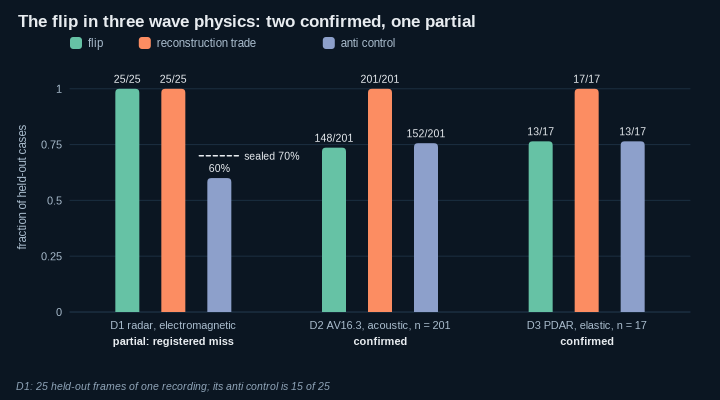
Figure 13.1. The three criteria of a flip on held-out data, in three wave physics (registration GO-P-2026-034). Bars are fractions of held-out cases: the read-preserving arm wins downstream (flip), the reconstruction-optimal arm reconstructs better (the trade), and the arm with the read direction destroyed is worst (the control). D2 and D3 are [predicted, hit] on disjoint held-out recordings and events. D1 is [predicted → partial, registered miss]: its control is 60% against a sealed bar of 70%, and its split is within one recording because the disjoint set could not be downloaded. The sealed bar is drawn for D1 only, since that is the one the chapter prints.
The non-physical confirmations
Beyond physics, the flip appears in consumers of pure information geometry.
Whale codas (W) — sealed flip. Sperm-whale coda dialect, a clan classifier, 8718 codas of inter-click-interval rhythm. Held-out read-preserving AUROC 0.934 > recon-optimal 0.883, recon-trade (O reconstructs 2× better yet downstream-worse), flip 300/300 [predicted, hit — GO-P-2026-038, promoted from an (A2) verdict]. Distinct biology from every other row, and the clean proof (Chapter 12) that the regime map needs two axes.
Legal (L) — the identifiability story. Citation-ranking, read operator recovered blind, 035 miss → 036/039 hit on a virgin split (R=0.796 > O=0.780, double the margin) [predicted, hit — GO-P-2026-039]. The first real-consumer demonstration that the blind probe recovers a read operator that is both misaligned-with-energy and generalizing.
Moral, music, KV-keys (M, Mu, K) — (A2) verdicts. Consistent with the flip via the proxy probe but not sealed two-metric flips, and labeled as verdicts, not flips. The book does not upgrade them.
What the negatives bought
The sweep’s honest negatives were more informative than its confirmations, and they are the reason the boundary conditions of Chapter 12 exist. D4 (optimization) is a true coupling null — anti-probe 300/300 but flip 27%, because curvature and gradient energy coincide in a trained model; not a data gap, a boundary [refuted, as a flip]. 035 was an identifiability failure that the blind probe fixed. D1 is data-limited and says so. The registration discipline caught its own over-reach twice in this sweep — the NEG-14 shortcut and the 035 estimated read operator — which is exactly what the discipline is for.
The verdict of the sweep
The consumer-relative flip is a property of observation wherever the read operator can
be identified. It confirms, as a sealed flip, across acoustic, seismic, and synthetic
physics, a dialect classifier, and citation retrieval; LLM attention shows the weaker
worse-arm discrimination (row A2, not a flip), and the moral and genre classifiers give (A2) verdicts
consistent with it. It fails,
informatively, exactly where the read operator is unidentifiable (fixable), coupled to
the signal (a boundary), or attached to a consumer that does not work (a precondition).
The one-encoder question is thereby answered — adapt, don’t universalize — and the
diagnostic that decides the encoding is probe_quotient, per domain, on two axes. Chapter
14 zooms from the sweep’s breadth to the falsifiable core’s depth: the GO-1…GO-6 spine and
how a claim earns each of its class tags.