Chapter 22 — The Freshness Sweep
STUB [A] — draftable now. Source: the
observation-theory-campaignsfreshness tracks +SEALS.md. Parallel in form to Ch. 13 (the allocation sweep). House rule: the umbrella cites only[replicated]/[demonstrated]rows; breadth rows are carried at their honest class; the negative is kept at full prominence.
What this chapter must establish
One witnessed-certificate grammar, measured across substrates — the freshness counterpart of the 12-domain allocation sweep. Per domain: certificate → witness, sealed bars, naive vs witnessed FC, verdict, tier.
| Domain | Cell(s) | Substrate | naive → witnessed | Class |
|---|---|---|---|---|
| Interdomain routing | BGP/IS-IS/OSPF/RPKI, BMP, D8 | RIS beacons + labs | 0.351/0.184/0.083 → detector band | [replicated] |
| Replication & coordination | PG/MG/PGX/GEO/ZK | real PG/Mongo/ZK, NRP | ~0.5 → ~0.02–0.06; ZK 0.99/0.01→0 | [replicated] |
| Cellular PHY/RAN | CSI/BEAM/AICSI/HO/URLLC/PHY | Sionna 5G NR | 0.28–0.47 → 0.05–0.13 | [demonstrated] |
| Optical | QOT | GNPy GN-model | ~0.40 → ~0 per footprint | [predicted] |
| Power grid | GRID | pandapower AC-PF | ~0.25 → ~0.01 | [predicted] |
| AI evaluation | LLM | roberta-mnli / HANS | (shakedown) | [predicted] |
| Quantum devices | QUANTUM | qiskit-aer (hand-built) | 0.28–0.43 → 0 | [exploratory] |
| Markets | QUOTE | efficient-price sim | 0.37 → 0.003 | [exploratory] |
| Sensing | (sensor) | real UCI field data | drift real; linear recalibration recovers only ~1.6× | [refuted] |
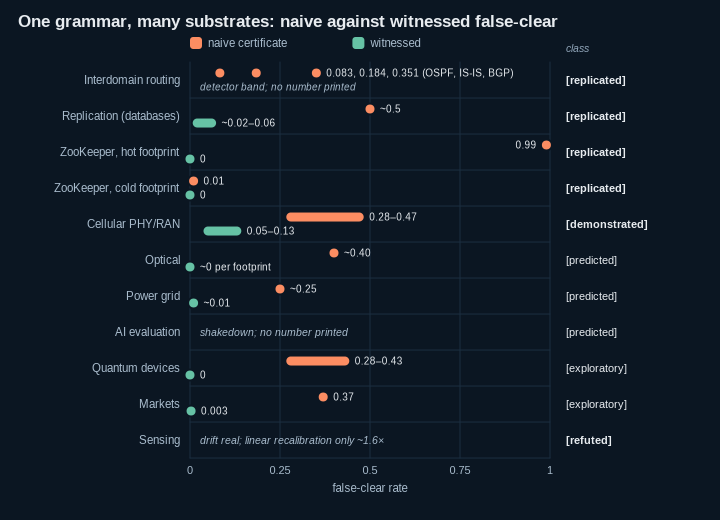
Figure 22.1. The freshness sweep of the outline’s table, drawn on one axis. For each domain the upper mark is the false-clear rate of the naive certificate and the lower mark is the rate once the certificate is witnessed. A bar is a range and a single dot is one value, both as the table prints them, approximate values included. The class of each row is at the right, and rows keep their own class: routing and replication are [replicated], cellular is [demonstrated], optical, grid and AI evaluation are [predicted], quantum and markets are [exploratory]. Sensing is [refuted]: the clean template failed and no false-clear pair is printed for it. The outline does not claim that the magnitudes coincide across domains.
Narrative beats
- The replicated core (routing + replication/coordination): the vacuity result reproduced across six independent data substrates and two witness kinds (LSN/oplog/zxid). The umbrella rests here.
- The demonstrated wing (cellular): the certificate ages under a physical coherence process, HARQ-witnessed, on standards-grade LDPC. One of its cells is scope-corrected and is kept as a negative: the AICSI reconstruction-vs-consumer dissociation did not survive the community-standard substrate (real 3GPP CDL-C, a CsiNet-class codec, which false-clears 0.0 on every seed; the pre-registered kill fired, 2026-08-25), so that row is not a headline.
- The breadth (optical/grid/LLM/quantum/markets): the grammar transfers to new
substrates at
[predicted]/[exploratory]— pre-registered, awaiting sealed grading or a real substrate (IBM hardware, tick data). - The kept negative (sensor): drift is real but linear recalibration only partially recovers; the clean template failed honestly and is recorded, not tuned into a pass (the redesign — witness-triggered recalibration — is named, not claimed).
Boundary
Cross-domain magnitude constants are not claimed to coincide; each row stands at its own class. This is a generality-of-grammar result, not a universal-number result.