Chapter 17: What Politics Teaches the General Theory
“Every domain book must answer: what does this domain teach us that we could not learn from the general theory alone?” — Geometric Series, internal methodology note
RUNNING EXAMPLE — DISTRICT 7
District 7 has been our laboratory for sixteen chapters: a six-dimensional electorate forced through one-dimensional institutions, its preferences contracted to scalars, its manifold structure systematically destroyed by voting systems, campaigns, media, and redistricting. We have diagnosed the destruction, measured it with the Political Bond Index, and proposed partial remedies — RCV, deliberation, manifold-aware redistricting.
Now we step back and ask: what has District 7 taught the Geometric Series? What features of the political domain are unique — lessons that could not have been learned from ethics, economics, law, cognition, communication, or medicine alone? This chapter identifies five, among them the discrete-continuous tension, the Hohfeldian symmetry of political relations, and the geometry of collective choice.
Lesson 1: The Discrete-Continuous Tension Is Maximized in Politics
Every domain in the Geometric Series involves a mismatch between the continuous structure of the domain manifold and the discrete structure of institutional outputs. In ethics, the 9-dimensional moral manifold is contracted to scalar moral judgments. In economics, the decision manifold is contracted to prices and quantities. In law, the judicial manifold is contracted to verdicts and sentences. In medicine, the clinical manifold is contracted to diagnoses and treatment plans.
Politics maximizes this mismatch.
The political preference manifold is continuous: preferences vary smoothly across the six-dimensional space, and small changes in a voter’s position produce small changes in their political behavior. But the political outcome space is radically discrete: binary votes (yea/nay), fixed candidate sets (choose one of five), winner-take-all districts (one representative per district), binary party identification (Democrat or Republican). No other domain in the series has such a severe mismatch between the input manifold’s dimensionality and the output space’s discreteness.
Consider the comparison:
| Domain | Input Manifold | Output Space | Contraction Severity |
|---|---|---|---|
| Economics | 9D decision manifold | Continuous prices, quantities | Moderate |
| Law | Judicial manifold | Ordinal sentences, binary verdicts | High |
| Medicine | Clinical manifold | Treatment spectra, ordinal triage | Moderate |
| Cognition | Cognitive manifold | Scalar test scores | High |
| Communication | Semantic manifold | Scalar metrics (BLEU, etc.) | High |
| Politics | 6D preference manifold | Binary votes, single winners | Extreme |
The severity of the contraction makes politics the most extreme test case for the Scalar Irrecoverability Theorem. The consequences of irrecoverability are most visible in politics: electoral chaos (McKelvey’s cycling), representation failures (the Representation Paradox), the illusion of polarization (the Polarization Illusion Theorem), and the systematic exclusion of suppressed dimensions from democratic representation.
The lesson for the general theory: the Scalar Irrecoverability Theorem predicts worse outcomes as the contraction ratio increases. Politics, with its extreme contraction (6D to binary), illustrates this prediction. The domain provides the sharpest test case for the theorem and the most compelling illustration of its practical significance.
Lesson 2: The Hohfeldian Symmetry of Political Relations
Note (2026-11-26). Geometric Ethics withdrew the dihedral group $D_4$ as the symmetry group of the Hohfeldian positions in its version 1.25 (November 2026). The two operations it demonstrates, the correlative exchange and the negation, are commuting involutions, and they generate the Klein four-group $V_4$, of order four. No quarter-turn that cycles the four positions has been demonstrated. The statements of this section that use only the two involutions stand: the four political relations, the correlative pairing of citizen and state positions, the opposition pairing, and the reading of a broken correlative as a gauge violation. The statements that depend on a quarter-turn or on a group of order eight are withdrawn pending restatement under $V_4$: the presentation of the full group with $r^4 = e$ and eight elements, and the claim that a universal $D_4$ is a structural invariant of the parent framework. Each is marked below.
The Hohfeldian symmetry group, first identified in Geometric Ethics (Ch. 8) and stated there since version 1.25 as the Klein four-group $V_4$, appears across the Geometric Series as the symmetry group of normative relations. In ethics, the group captures the correlative and opposite structure of Hohfeld’s jural relations: right-duty, liberty-no-right, power-liability, immunity-disability. In law, the same group governs the symmetries of legal positions. In communication, it captures the symmetries of communicative obligations and permissions.
Politics contributes its own instantiation of this symmetry. The four political relations are:
- Right (to vote, to speak, to associate, to petition)
- Duty (to serve on juries, to pay taxes, to obey law, to participate in civic life)
- Liberty (to abstain from voting, to dissent, to exit the political system)
- Exposure (to taxation, to conscription, to regulation, to the consequences of collective decisions)
These four relations form a square under the two symmetry operations of $V_4$:
Correlative symmetry ($r$): Swapping the citizen-state perspective. The citizen’s right to vote corresponds to the state’s duty to provide the ballot. The citizen’s duty to pay taxes corresponds to the state’s right to collect revenue. The citizen’s liberty to dissent corresponds to the state’s lack of right (no-right) to compel agreement. The citizen’s exposure to regulation corresponds to the state’s power to regulate.
Opposition symmetry ($s$): Negating the normative valence. Right opposes liberty (a right entails a correlative duty on others; a liberty does not). Duty opposes exposure (a duty is an obligation one bears; an exposure is a vulnerability one cannot escape).
[Withdrawn pending restatement under $V_4$, 2026-11-26] The full group $D_4 = \langle r, s \mid r^4 = s^2 = e, srs = r^{-1} \rangle$ — eight elements — is the same mathematical object that governs jural relations in Geometric Law and normative communication in Geometric Communication. The universality of $D_4$ across domains is evidence that it is a feature of the parent theory, not an accident of any particular domain.
The political instantiation contributes a specific insight: the correlative symmetry is not just a theoretical structure but an operational constraint on democratic institutions. A democratic system that respects the correlative symmetry treats the citizen-state relationship as genuinely symmetric: the citizen’s rights entail state duties, and the state’s powers entail citizen vulnerabilities. A system that breaks the symmetry — that grants the state powers without corresponding citizen rights, or imposes citizen duties without corresponding state obligations — is gauge-variant, and the gauge violation is measurable.
[Withdrawn pending restatement under $V_4$, 2026-11-26] The lesson for the general theory: the $D_4$ symmetry is a universal feature of normative relations, not domain-specific. Its appearance in ethics, law, communication, and politics confirms its status as a structural invariant of the parent framework.
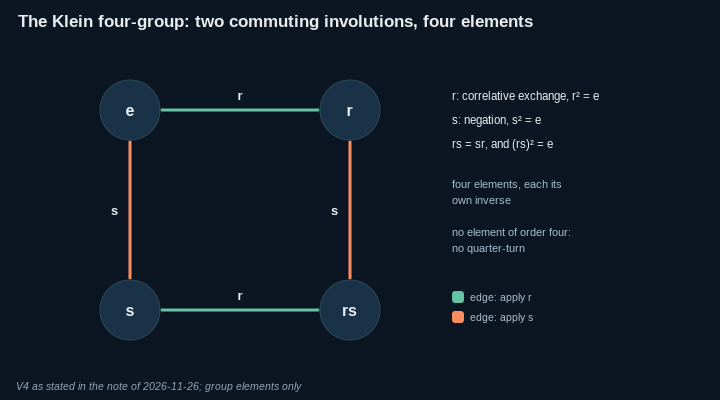
Figure 17.1. The group named in the dated note at the head of Lesson 2. The correlative exchange r and the negation s are commuting involutions and generate the Klein four-group V4 = {e, r, s, rs}. Each edge applies one of them, and applying it twice returns to the start. Every element is its own inverse and no element cycles four positions, so the group has order four. The corners are the group’s elements; the figure does not place the chapter’s four political relations on them.
Lesson 3: Collective Choice as a New Geometric Regime
The parent theory in Geometric Reasoning treats reasoning as individual navigation on a manifold. Each agent has a position, each agent computes a geodesic, each agent navigates toward their goal. The interactions between agents are modeled through the heuristic field (social influences shape the guidance) and the Bond Geodesic Equilibrium (multi-agent geodesic consistency), but the fundamental unit of analysis is the individual trajectory.
Politics introduces a new regime: collective navigation. Multiple agents occupy the same manifold. Their individual geodesics must be aggregated into a collective path. The aggregation is not optional — the collective must make decisions that bind all members, whether or not those decisions align with any individual member’s geodesic.
Arrow’s theorem says this aggregation is lossy. The political domain thus contributes a new regime to the parent theory — the geometry of collective choice, where the fundamental tension is not between scalar and tensor (as in individual reasoning) but between individual geodesics and their collective aggregation.
This regime does not appear in other domains of the series:
- Ethics treats individual moral reasoning: one agent navigating the moral manifold.
- Medicine treats individual clinical reasoning: one patient, one clinician.
- Communication treats signal between individuals: sender and receiver.
- Cognition treats individual cognitive processes.
- Economics comes closest to the collective regime through the BGE, but the BGE aggregates through market equilibrium, which preserves more dimensional structure than voting because prices are continuous.
Politics is unique in requiring binding collective decisions from individual preferences. The binding constraint — once the vote is tallied, everyone is governed by the result — is the source of the dimensional collapse. A market can tolerate different agents choosing different products (dimensional preservation through choice diversity). A democracy cannot tolerate different citizens being governed by different laws (the binding constraint forces a single collective output).
The lesson for the general theory: individual manifold navigation and collective manifold navigation are geometrically distinct regimes. The parent framework’s tools — heuristic fields, geodesic deviation, gauge invariance — apply to both, but the collective regime introduces new phenomena (Arrovian impossibility, McKelvey chaos, the Democratic Irrecoverability Theorem) that do not appear in the individual regime. A complete geometric theory of reasoning must account for both.
Lesson 4: Legitimacy as a Conserved Quantity?
Note (2026-11-26). Geometric Ethics withdrew “Conservation of Harm” as a conservation law in June 2026 and kept the weaker claim that harm accounting is invariant under re-description. The analogy this section draws on is weaker to that extent. The hypothesis about legitimacy was marked speculative from the start and remains so.
If the political Lagrangian is invariant under the democratic gauge group $G_D$ — voter anonymity, option neutrality, re-description invariance — then Noether’s theorem implies a conserved quantity. The candidate is democratic legitimacy: the property that an electoral outcome possesses when it was produced by a process that respects the gauge symmetries.
The conservation hypothesis: total legitimacy is preserved under gauge-invariant transformations. A system that satisfies anonymity, neutrality, and re-description invariance maintains its legitimacy regardless of which specific voters participate, which candidates run, or how the ballots are formatted. A system that violates these symmetries — that allows some votes to count more (breaking anonymity), that structurally advantages some candidates (breaking neutrality), or that produces different outcomes depending on ballot design (breaking re-description invariance) — loses legitimacy.
This is speculative. The analogy between political gauge invariance and physical gauge invariance is suggestive, and the conservation claim has intuitive appeal: democratic legitimacy does seem to be a quantity that persists under fair procedures and degrades under unfair ones. But the mathematical rigor of a Noether-type conservation law requires a well-defined Lagrangian, and the political Lagrangian — if it exists at all — has not been specified.
The lesson for the general theory is the question itself: does the gauge-invariance framework, which produces genuine conservation laws in physics and plausible invariance principles in ethics (representation-invariance of harm accounting) and economics (conservation of value under re-description), produce a meaningful conservation law in politics? The answer is unknown, and the chapter is honest about that. The gap between the analogy and a rigorous result is a genuine open question.
Lesson 5: The Feedback Between Institutions and Manifold
The other domains in the Geometric Series treat the manifold as exogenous — the moral manifold, the economic manifold, the clinical manifold exist independently of the institutions that operate on them. In politics, the manifold and the institutions co-evolve: the electoral system shapes which dimensions of preference are politically activated, and the activation shapes which dimensions voters develop positions on.
Consider: Do voters hold independent positions on environmental policy ($d_3$) because environmental policy is genuinely independent, or because the political system has (recently) begun to treat it as an independent issue? In the 1970s, before the emergence of environmentalism as a political force, $d_3$ was not an independent dimension of most voters’ political identity. Environmental attitudes were absorbed into the economic dimension (conservation as a value of the economic right) or the social dimension (environmental protection as a progressive social cause). The dimension became independent when political institutions — parties, campaigns, media — began to treat it as independent.
This feedback — institutions creating the manifold dimensions they then operate on — does not appear in the other domains. The clinical manifold’s dimensions (organ systems, functional status) exist independently of the healthcare system. The moral manifold’s dimensions (Hohfeldian relations, harm, autonomy) exist independently of ethical institutions. But the political manifold’s dimensions are partially constituted by the political institutions that the manifold is supposed to describe.
The feedback has profound implications for the framework’s normative claims. If the political manifold is partially constituted by institutions, then the Democratic Irrecoverability Theorem’s diagnosis — that voting systems lose manifold information — is itself institution-dependent. A different set of institutions might produce a different manifold with different dimensionality, and the irrecoverability bound might be different.
The lesson for the general theory: in some domains, the manifold and the institutions are not separable. The geometry is not a fixed background on which institutions operate but a dynamic structure that institutions help create. A complete geometric theory must account for this co-evolution — the feedback between the manifold and the contraction operators that act on it.
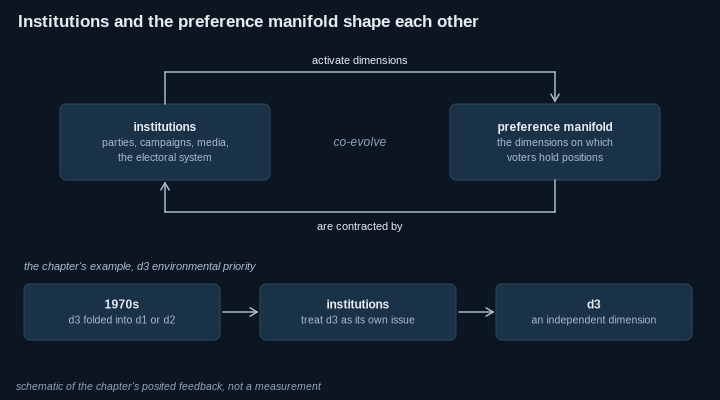
Figure 17.2. Lesson 5 as a loop. Institutions (parties, campaigns, media, the electoral system) decide which dimensions are politically activated, and activation decides which dimensions voters hold positions on; the institutions then contract the manifold they helped to shape. Below, the chapter’s example: environmental priority, d3, absorbed into d1 or d2 in the 1970s, became an independent dimension when institutions began to treat it as one. A schematic of the chapter’s posited feedback.
District 7: Four Lessons
We use District 7 to illustrate the first four lessons:
The discrete-continuous tension: District 7’s continuous manifold (200,000 voters on a 6D space, each with a precise position) is forced through binary votes (each voter selects one candidate) to produce a single winner. The contraction ratio is $200{,}000 \times 6 : 1$ — over a million dimensions of input compressed to a single output. The severity is visible in the results: five different voting systems produce three different winners from the same electorate (Chapter 5).
The Hohfeldian symmetry: When District 7 votes on a local bond measure, the citizen-state relationship instantiates all four correlative pairs: the citizen’s right to vote (and the state’s duty to provide the ballot), the citizen’s duty to pay the tax if the measure passes (and the state’s right to collect it), the citizen’s liberty to vote no (and the state’s no-right to compel a yes vote), and the citizen’s exposure to the tax regardless of their vote (and the state’s power to impose it). The correlative structure is not academic — it defines the normative framework within which the bond measure is legitimate.
Collective choice: District 7 cannot escape the collective regime. The transportation plan, the budget allocation, the bond measure — all require binding collective decisions. The citizens’ assembly (Chapter 14) found a plan that no individual initially supported, demonstrating that the collective optimum on the manifold differs from any individual optimum. This is a genuinely collective phenomenon: it requires aggregation across individual geodesics.
Legitimacy conservation: When Map B (the gerrymander) is implemented, District 7’s voters perceive a loss of legitimacy. The gerrymander violates anonymity (by treating voters differently based on their geography, which is a proxy for their manifold position) and neutrality (by structurally advantaging one party). The loss of legitimacy is felt as alienation, disengagement, and distrust — exactly the $d_5$ dimension that the gerrymander exploited. In this illustrative scenario, the violation of gauge symmetry produces the degradation that the conservation hypothesis would predict.
DISTRICT 7 — CHAPTER SUMMARY
We have identified five lessons that politics teaches the general geometric theory: (1) the discrete-continuous tension is maximized in politics, making it the sharpest test case for the Scalar Irrecoverability Theorem; (2) the Hohfeldian symmetry of normative relations, the Klein four-group $V_4$, has a specific political instantiation that constrains democratic institutions; (3) collective choice is a geometric regime distinct from individual reasoning, with its own impossibility results and aggregation challenges; (4) democratic legitimacy may be a conserved quantity under gauge-invariant transformations, though this hypothesis remains unproven; and (5) the political manifold and the institutions that act on it co-evolve.
In Chapter 18 — the final chapter — we survey the open questions: the frontier of the geometric theory of politics, where the mathematics outpaces our understanding and the questions outnumber the answers.