Chapter 1 — Why Observation Needs a Theory
Three engineers, in three different buildings, are about to make the same mistake.
The first is Maya, whom you met in the Preface. She has quantized a language model’s key–value cache to the lowest reconstruction error her team has ever recorded, and the model has quietly gotten worse. The second is Devi, who builds the retrieval index for a legal-search product; she has a new embedding compressor that shrinks her vector database by 60% with almost no change in average vector fidelity, and her citation-ranking accuracy has fallen off a cliff for reasons her dashboards cannot locate. The third is Sun-ho, who works on a direction-finding array — microphones, in his case, though it could as easily be radar or a seismometer network. He has a codec that compresses the array snapshots with beautiful waveform fidelity, and his estimator now points a few degrees wrong, consistently, in a way that averages out to nothing and so hides in every summary statistic he trusts. (The three are composites, and their numbers are illustrative.)
None of the three has a bug. Each has a compressor that does exactly what it was asked to do — minimize the difference between the input and its reconstruction — and each has a downstream system that does not care about that difference. The attention head reads a few directions of Maya’s keys. The ranking function reads a projection of Devi’s embeddings. The estimator reads the angle, not the magnitude, of Sun-ho’s snapshots. In every case the compressor spread its error to be small on average, which is to say it put error everywhere, which is to say it put error exactly where the consumer was looking. They optimized a quantity that was never the one that mattered, and they optimized it well.
This book is about the quantity that mattered.
The claim
Here is the thesis of the whole volume, stated once, plainly, so that everything after it is commentary.
Operational geometry, distortion, and reliability are not properties of an object. They are properties of a relation — among an object $x$, an observer $O$, a channel that carries $x$ to $O$, and a resolution budget $B$ — and they are ill-posed until all four are named.
The word doing the work is observer. In this book an observer is not a viewpoint, not a person, not a measuring instrument in the physicist’s sense. It is a triple
$$ O = (C, G, B): $$
a consumer $C$ — the thing that acts on the representation, a classifier, an attention head, an estimator, a ranking function; an output metric $G$ — how the consumer’s downstream errors are scored; and a budget $B$ — the bits, or the resolution, you are allowed to spend. Give me those three and I can tell you what the observer can distinguish, what it must discard, and what it will cost to serve it. Withhold any one of them and the questions “how much geometry survived this compression?” and “how good is this code?” have no answers — not hard answers, no answers, the way “how far away is it?” has no answer until you say from where.
The engineers’ mistake was to answer a relational question with an absolute number. Reconstruction error — mean squared error, PSNR, cosine similarity — is a property of $x$ and its reconstruction $\hat x$ alone. It names no consumer. It is, as Chapter 2 will make precise, the special case of the right quantity when the consumer happens to read everything equally, and that case is neither typical nor the one any of the three engineers were in.
What the observer reads: the read metric
The mechanism that resolves all three stories is a single operator. Fix a consumer $C$ and ask the only question that matters: how much does the consumer’s output move when you perturb its input? Differentiate $C$ at the operating point to get its Jacobian $J$, pull the output metric $G$ back through it, and you have
$$ P_C = J^{\top} G\, J, $$
a symmetric, positive-semidefinite operator we will call the read metric. Its range is the small set of directions the consumer can actually tell apart — the read subspace. Its kernel is everything the consumer is constitutionally blind to — the nuisance. Maya’s attention head has a read metric whose range is spanned by its query directions; the across-token mean is in the kernel. Sun-ho’s estimator has a read metric that sees the angle and not the magnitude. Devi’s ranker reads a projection and discards the off-subspace energy. Three unrelated systems, one object.
And the quantity the engineers should have been minimizing is not the size of the coding error $\delta = \hat x - x$, but the size of the error where the consumer looks:
$$ \operatorname{tr}(P_C\, \Sigma_\delta), $$
the error covariance projected onto the read metric. This trace and the total reconstruction error $\operatorname{tr}(\Sigma_\delta)$ are different numbers, and — this is the entire drama of the book — they can move in opposite directions. A code that makes the first small can make the second large, and vice versa. When they disagree about which of two codes is better, we call the disagreement the consumer-relative flip, and Chapter 8 shows it is not a curiosity but a reproducible property of observation, put at risk across twelve domains and three branches of physics and confirmed as a sealed flip in six of them (Chapter 13).
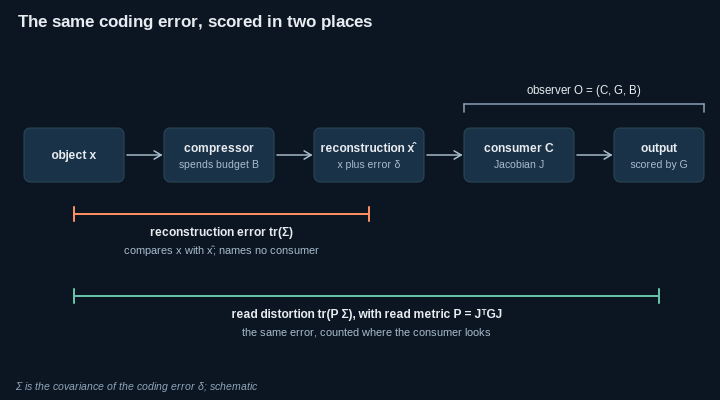
Figure 1.1. A schematic of the two places a code can be scored. Reconstruction error compares the object x with its reconstruction and stops there, so it names no consumer. The read distortion scores the same coding error after weighting it by the read metric, the output metric G pulled back through the consumer’s Jacobian J. The consumer, the output metric and the budget together are the observer.
One object, three shadows
The read metric $P_C$ is the whole book, seen once. But it casts three shadows, and the three shadows were discovered as three separate subjects before anyone noticed they were one. This volume is organized around that unification.
-
COST — what observation charges. If a consumer reads only $P_C$, the bits you must pay to serve it to a given distortion are governed by a tilted rate–distortion function $R_C(D)$, not Shannon’s. The tilt bends the optimal bit-allocation toward the read subspace, and it comes with achievability and converse theorems, a rate region for two observers, a tax for using the wrong read metric, and a floor of irreducible error you hit when your code is blind to a direction the consumer needs. This is Part III’s Chapter 7. (Paper III.)
-
VALUE — what preserving the read buys. This is the flip: at matched bits, keeping $P_C$ beats reconstructing $x$, and the gap is real money on real tasks. Chapter 8. (Papers II and IV.)
-
LEGIBILITY — what the quotient reveals. When you quotient an object by what an observer cannot see, the structure that survives is often the structure you wanted. In spectral embeddings, the observer that ranks by geodesic distance reads the angle and discards the radius, and so the angle carries the geometry that the distance-based reading loses. This is Keep-the-Angle, Chapter 9. (Papers I and I.5.)
Cost, value, legibility: the price of the read, the payoff of the read, the meaning of the read. Three literatures, three sets of tools, one operator. The intellectual content of this book is the claim that they are the same, and the discipline of this book is the ledger that keeps the claim honest.
Why a theory, and not just a warning
One could stop at the warning: do not trust reconstruction error; know your consumer. That warning is true and it is not enough, because it gives no way to act. A theory has to do three things the warning cannot.
It has to say which directions the consumer reads — and it does, via the read metric, which Chapter 10 shows can be recovered blind, from the consumer’s outputs alone, with no labels and no oracle. It has to say when the flip appears and when it does not — and it does, via the alignment law $\kappa$ of Chapter 12, which turns “know your consumer” from folklore into an ordinal dial you can measure before you compress (an exact null condition, not a law of the flip’s size). And it has to say what it costs to do the right thing — and it does, via the rate–distortion theory of Chapter 7. A warning tells you to be careful. A theory tells you what to compute.
The rest of Part I clears the ground: Chapter 2 shows precisely how reconstruction-error thinking fails and why it was ever plausible, and Chapter 3 places the read metric where it belongs in the histories of information theory and information geometry — as an old object we did not invent, pressed into a new job we claim it was always the right tool for. Then Part II builds the framework from the operator up.
A last word before we begin, because it governs everything. This is a program co-designed with an embedded AI assistant, and it operates under a written charter whose first rule is that the assistant may not be the sole grader of its own work, and whose house rule — the house rule of this volume, which Geometric Ethics and Geometric Cognition, the other volumes that keep claim ledgers, share — is that the book may not assert what the ledger cannot show. When a sentence in this book carries a tag like [demonstrated] or [refuted], that tag is a promise about a specific row in a specific ledger, and, where the row is a registered test, sealed before it was measured. The three engineers’ mistake was to trust a number that named no consumer. The correction is not to trust a different number more; it is to say, every time, whose number it is, and to show the receipt.