Chapter 2 — The Failure of Observer-Free Measurement
The reconstruction error is one of the most useful numbers in engineering, and this chapter is going to spend its length arguing against trusting it. So let me be fair to it first, because the argument only lands if you see why the number was ever worth trusting.
Why reconstruction error earned its authority
Mean squared error has three virtues, and they are real. It is cheap — you compute it from the input and the reconstruction, with no knowledge of what happens downstream. It is universal — it gives every compressor a single comparable score, so you can rank codecs on a leaderboard without knowing what anyone will do with the output. And it is theoretically blessed — it is the distortion measure for which Shannon’s rate–distortion theory is cleanest, for which the Gaussian source has a closed form, for which reverse water-filling gives the optimal bit-allocation in a line of algebra. A generation of compression was built on it and the buildings are standing.
The three virtues are a single vice wearing three coats. Reconstruction error is cheap, universal, and blessed because it names no consumer. It scores $x$ against $\hat x$ and asks nothing about who reads the result. That is exactly what makes it portable, and exactly what makes it wrong when portability is a lie — when the thing downstream does not, in fact, read $x$ the way MSE assumes it does, which is to say uniformly, every direction weighted the same.
The slice, mistaken for the whole
Here is the precise relationship, because vagueness here is the whole problem. Downstream loss, to first order, is governed by the read distortion $\operatorname{tr}(P_C \Sigma_\delta)$ — the coding-error covariance projected onto the consumer’s read metric. Total reconstruction error is $\operatorname{tr}(\Sigma_\delta)$. These coincide in exactly one case:
$$ \operatorname{tr}(P_C \Sigma_\delta) = \operatorname{tr}(\Sigma_\delta) \quad\Longleftrightarrow\quad P_C = I. $$
Reconstruction error is the read distortion of the consumer that reads every direction equally. It is not universal; it is the $P_C = I$ slice of a family of distortion measures, one per observer. It became the default because the tools — the closed forms, the water-filling, the leaderboards — were built for the slice, and a tool built for a slice will make everything look like that slice. When your consumer is genuinely isotropic, MSE is not an approximation to the right answer; it is the right answer, and this book has no quarrel with you. The quarrel begins the moment $P_C \ne I$, which is the moment you have a consumer that cares about some directions more than others — a classifier, an attention head, a ranker, an estimator — which is to say almost always.
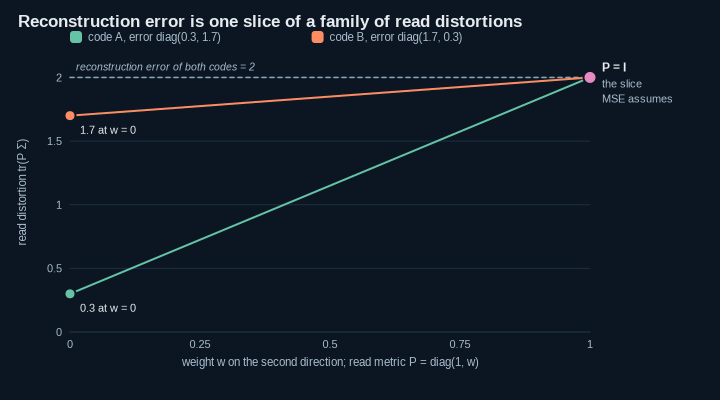
Figure 2.1. Reconstruction error as one slice of a family. The two codes are the errors A and B of Figure 5.1, with covariances diag(0.3, 1.7) and diag(1.7, 0.3), so both have reconstruction error 2. The horizontal axis is the weight w that a consumer with read metric diag(1, w) gives the second direction, and the vertical axis is the read distortion. The two measures agree only at w = 1, where the read metric is the identity, and there the two codes tie. The values are illustrative, not measured.
What the failure looks like in the wild
Abstractions persuade slowly; sealed refutations persuade fast. The program’s ledger carries two standing negatives that are nothing but this failure, measured.
The motivating negative (NEG-2): cosine 0.995, perplexity $10^4$. In the key-quantization work behind Paper II, a compressed key cache reached a cosine similarity of $0.995$ with the original — by the reconstruction yardstick, all but perfect — while the language model’s perplexity blew up to the order of $10^4$ [refuted]. The reconstruction number said “lossless.” The consumer said “ruined.” Nothing was wrong with either measurement. They were measuring different things, and only one of them was the thing the product shipped.
The calibration negative (NEG-4): a “better” code that is worse. A lightweight online (Lloyd) recalibration of the key quantizer improved reconstruction and made the downstream softmax-KL divergence worse [refuted]. This is the failure in its purest form: an optimization that measurably moves the reconstruction number in the good direction and the consumer’s number in the bad direction, at the same time, on purpose. Reconstruction is not a noisy proxy for downstream quality here. It is an anti-correlated one, in this measurement.
If reconstruction error were merely imprecise — a proxy with some scatter — you could correct for the scatter and move on. The reason you cannot is that the disagreement is not noise. It is structure: the coding error that MSE rewards you for spreading evenly is, from the consumer’s side, error deposited into the read subspace. The better your reconstruction, the more democratic your error, the more of it lands where the consumer looks. This is why the two numbers can be not just different but opposed, and it is the seed of the flip (Chapter 8).
The category error
Step back from the numbers and the mistake is a category error. “How good is this compressor?” is treated as a question about the compressor. It is not. It is a question about the pair — the compressor and the consumer — and a compressor has no downstream quality on its own, any more than a key has a “fit” without a lock. The ledger states this as a discovered principle, sharpened through a ladder of refuted proxies on the KV-key domain (NEG-5 through NEG-9, Chapter 16): invariant-preservation is a property of the (compressor, consumer) pair, not of the compressor [refuted, of each proxy that tried to make it a compressor property]. The single sharpest instance is NEG-7: at fixed reconstruction error, the downstream ranking of two codes flips depending on which consumer reads them. When the reconstruction is held equal and the verdict still changes, the verdict was never about the reconstruction.
The practical corollary is uncomfortable, and this book will not soften it. Every leaderboard that ranks compressors by reconstruction fidelity is answering the wrong question for every consumer that is not isotropic — which, on modern learned representations, is essentially all of them. The number is not useless; it is unanswerable-as-posed, a relational quantity reported as an absolute one. The fix is not a better reconstruction metric. It is to name the observer, compute $P_C$, and score $\operatorname{tr}(P_C\Sigma_\delta)$ — and, when you cannot write $P_C$ down, to recover it, which Chapter 10 shows you can do blind.
What this does not mean
Three guardrails, because over-reading this chapter is its own failure mode.
It does not mean reconstruction is dead. When $P_C \approx I$ — many lossy-image and lossy-audio pipelines aimed at a human viewer whose sensitivity is broadly distributed — the slice is where you live and the classical tools are correct. Know which case you are in; do not abandon a right tool because it can be misused.
It does not mean any consumer-aware number will do. The read distortion is a specific quantity, and the program has refuted several plausible substitutes for it: an error-magnitude scalar (NEG-6), a variance-ratio proxy (NEG-8), even the read distortion trace itself as a complete rank statistic (NEG-9, where the trace nails the discriminating comparison but misorders a middle pair). “Consumer-aware” is a direction, not a destination; the destination is $\operatorname{tr}(P_C\Sigma_\delta)$, with its known limits stated.
And it does not mean the consumer must be known in closed form. The most common objection — “I don’t have $J$; my consumer is a trained network I cannot differentiate by hand” — is answered in Chapter 10, where the read metric is recovered from the consumer’s input–output behavior alone. You do not need to write the observer down. You need to admit it exists, and measure it.
Observer-free measurement failed for the three engineers of Chapter 1 not because their instruments were bad but because they measured a relation as if it were a property. The next chapter shows that the object they needed — the read metric — has been sitting in the mathematics the whole time, under a different name, waiting for the job.