Chapter 3 — Historical Precursors: Shannon, Rate–Distortion, and Information Geometry
I want to be scrupulous about what is new here and what is not, because the honest answer is that almost none of the components are new, and the claim of the book is entirely about the composition. This chapter is the positioning paragraph, written once, at length, so that later chapters can point back and no reader is left thinking the read metric was pulled from nowhere. It was pulled from four places, each of which owns part of it.
Shannon, and the birth of the slice
Rate–distortion theory begins with Shannon: to reproduce a source $x$ to within an average distortion $D$ under a fidelity measure $d(x,\hat x)$, you need at least $R(D)$ bits, and $R(D)$ is achievable. For a Gaussian source under squared-error distortion the theory is at its most beautiful — the optimal bit-allocation across the source’s eigen-directions is reverse water-filling, pouring bits into the high-variance directions and abandoning the ones below a threshold. This is the mathematics behind transform coding, behind JPEG, behind essentially every codec of the twentieth century.
Notice what fixed the fidelity measure. Squared error weights every coordinate of $x$ equally; it is the distortion of an observer that reads all directions the same. Shannon’s theory is not wrong to make this choice — it is a theory given a fidelity measure, and squared error is a fine one to develop first. But the choice quietly installed the slice as the default. Everything downstream inherited it: reverse water-filling allocates bits by source variance, because under squared error the directions that matter are the directions where the source varies. The moment the distortion measure is not isotropic — the moment it is $\operatorname{tr}(P_C \Sigma_\delta)$ for some non-identity $P_C$ — the water-filling must be done in a different basis, the one that diagonalizes $P_C$ against the source, and the bits flow toward what the observer reads rather than what the source varies. That retilting is the whole content of the COST shadow (Chapter 7). It is Shannon’s theory with the fidelity measure taken seriously as a variable, not a constant.
Weighted and perceptual distortion: the slice, tilted, but ad hoc
Engineers did not wait for a theory to notice that squared error was the wrong yardstick. Perceptual coding — weighting quantization error by a model of human vision or hearing — is exactly the practice of replacing $I$ with a non-identity weighting because the consumer (an eye, an ear) does not read uniformly. So is weighted MSE in a hundred application papers. The read metric is not a stranger to this tradition; it is its formalization and its generalization. What those literatures lacked was (i) a principled account of where the weighting comes from — it was hand-tuned per application — and (ii) the recognition that the weighting is the pullback of the consumer’s own output metric, computable from the consumer, and often recoverable blind (Chapter 10). Perceptual coding tilted the slice by hand for one consumer, the human sensory system. The read metric says: every consumer has such a tilt, it is $P_C = J^\top G J$, and you can get it from the consumer instead of guessing it.
Amari and Čencov: the pullback metric already exists
Here is the component I least want to over-claim. The object $P_C = J^\top G J$ — a metric on an input space obtained by pulling a metric on an output space back through a map — is the pullback metric, and it is old. In information geometry, Čencov’s theorem singles out the Fisher information metric as the unique (up to scale) metric invariant under sufficient statistics, and Amari’s program develops the differential geometry of statistical manifolds on exactly this foundation: a model is a manifold, the Fisher information is its metric, and pulling it back through reparametrizations is the daily bread of the subject. When the consumer $C$ is a probability model and $G$ is the Fisher metric on its outputs, $P_C$ is a Fisher-information pullback. The machinery is Amari’s and Čencov’s, and I claim none of it.
What I claim is the job. The information-geometry tradition studies the pullback metric to understand estimation and inference on statistical manifolds — natural gradient, the geometry of the EM algorithm, the second-order structure of learning. It does not, as far as this program found, treat the pullback as the governing object for lossy representation across domains — as the thing that decides whether your quantizer, your embedding, your array codec is good, and that unifies compression, spectral embedding, and physical estimation under one operator. The synthesis is the claim: this classical pullback is the operative object for serving representations to consumers, and naming it as such dissolves a family of unrelated engineering surprises into one mechanism with one dial. The components are Čencov’s and Amari’s; the sentence is the contribution. I state this here so that when the Skeptic’s Appendix meets the objection “isn’t $P_C$ just Fisher information?”, the answer is already on the table: yes, in the case where the consumer is a likelihood — and the point is not the operator but the load it is asked to bear.
von Luxburg–Radl–Hein, and the collapse that started it
The empirical seed of the book is a discouraging theorem. Von Luxburg, Radl, and Hein showed that the commute-time (resistance) distance derived from a graph Laplacian degenerates as the graph grows: pairwise commute distances converge to a function of the two nodes’ local degrees, losing the global geometry the embedding was supposed to reveal. Read as a verdict on the tool, it says spectral embedding dies at scale.
Read through the observer, it says something narrower and recoverable. The commute distance is the reading of the embedding by one consumer — the one that ranks by that distance — and the theorem is a statement about that consumer’s read metric. Put the embedding in polar form and the collapse is confined to the radial coordinate; the angular coordinate keeps the geodesics (proved in Paper I; not yet a ledger row). The geometry did not vanish; it moved into the coordinate the distance-reading discards. This is the LEGIBILITY shadow (Chapter 9), and it is the concrete case that taught the program the general lesson: a degeneracy theorem for a representation is often a theorem about one observer’s read metric, and a different observer reads the surviving structure fine.
Ng–Jordan–Weiss: the folk practice awaiting a reason
There is one more precursor, and it is a piece of folklore that turned out to be a theorem. In spectral clustering, the Ng–Jordan–Weiss algorithm row-normalizes the embedding — projects every node onto the unit sphere, keeping direction and throwing away magnitude — before clustering. Practitioners did this because it worked; the justifications were heuristic. The polar decomposition of the collapse theorem supplies the missing reason: row-normalization is exactly the projection onto the angular coordinate, which is exactly the read subspace of the geodesic-ranking consumer, which is exactly the coordinate the collapse spares. A move made for a decade on the grounds that it improved results turns out to be the optimal thing to do for a specific, identifiable observer. Folk practice is often a theory that has not been written down; here the read metric writes it down.
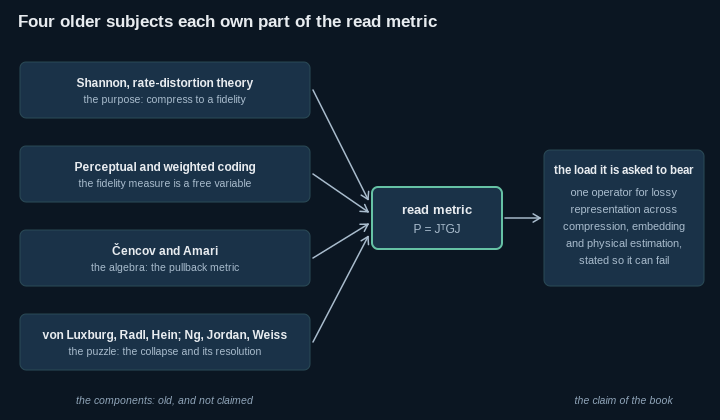
Figure 3.1. A schematic of the lineage the chapter sets out. Each of four older subjects supplies one part of the read metric, named under it. The book claims none of the parts. What it adds is the load placed on the operator, shown on the right.
The lineage, in one sentence
The read metric inherits its algebra from the pullback metric of Čencov and Amari, its purpose-of-compression from Shannon and rate–distortion, its acknowledgment that the fidelity measure is a free variable from perceptual coding, and its founding empirical puzzle from von Luxburg’s collapse and its NJW resolution. What it adds is the load: the claim that this one operator is the right object for lossy representation in general, across compression, embedding, and physical estimation, and that the claim is falsifiable, has been put at risk, and — where it survived and where it did not — is written in a ledger. With the lineage on the table, Part II can build the framework without owing anyone an unpaid debt.