Chapter 4 — The Observer Triple $O = (C, G, B)$
Part I argued that geometry, distortion, and reliability are relational and that the missing term in the relation is the observer. This chapter defines the observer precisely enough to compute with, and then spends its second half doing the one thing that makes an abstraction believable: naming six real observers and reading off, for each, what it sees and what it throws away.
The definition
An observer is a triple
$$ O = (C, G, B). $$
-
$C : X \to Y$ is the consumer: the map from the representation to whatever acts on it. $C$ can be a linear read-out, a trained classifier, an attention head, a direction-of-arrival estimator, a ranking function. It is, deliberately, whatever is downstream. $X$ is the space of the thing you are compressing or embedding; $Y$ is the space of the consumer’s outputs.
-
$G$ is the output metric on $Y$: how the consumer’s downstream errors are scored. For a classifier producing logits, $G$ might be the Fisher metric of the softmax; for an estimator producing an angle, $G$ is squared angular error; for a ranker, the metric that scores rank distortion. $G$ is where “what counts as a downstream mistake” is written down.
-
$B$ is the budget: the resolution you may spend — bits per symbol, codebook size, embedding dimension. Every verdict in this book is budget-relative; a code that wins at one budget can lose at another, and Chapter 8’s flip and Chapter 7’s rate–distortion curves are statements about how the verdict moves with $B$.
The triple is the whole of the observer. Nothing else about “who is looking” enters the theory. In particular there is no privileged, observer-free description of $x$ that the observer then “sees imperfectly.” There is $x$, and there are observers, and each observer induces its own geometry on the space of $x$. That is the content of calling the framework consumer-relative: the relativity is not epistemic modesty, it is the structure.
What the triple induces
Two objects follow immediately from the triple, and they are the objects the rest of the book computes with. The first is the read metric
$$ P_C = J^{\top} G\, J, \qquad J = \partial C \big|_{x_0}, $$
the pullback of the output metric through the consumer’s Jacobian at the operating point $x_0$ (Chapter 5 develops it in full). The second is the quotient $X / \!\sim_C$, in which two inputs are identified when the consumer cannot tell them apart — when their difference lies in $\ker P_C$. The read metric says how finely the observer resolves each direction; the quotient says which world the observer actually acts on, the world with the unreadable directions collapsed to points.
An observer, operationally, is its read metric and quotient, up to budget. Two consumers with the same $P_C$ are the same observer for our purposes even if their internals differ wildly; two consumers with different $P_C$ are different observers even if they share a name. This is why the framework can carry a single mechanism across a language model and a seismometer array: they are unrelated machines with, sometimes, the same read metric structure.
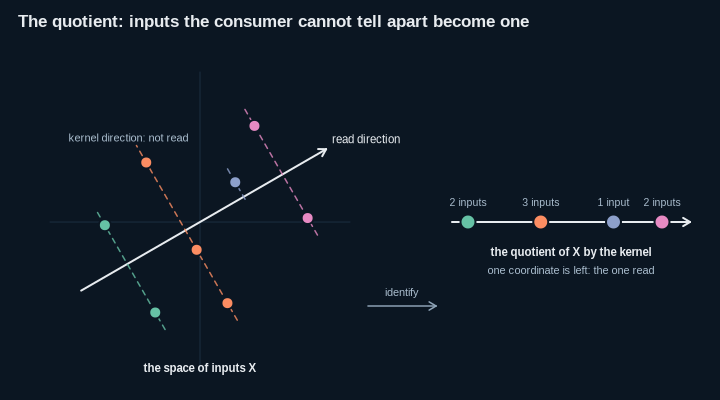
Figure 4.1. The quotient for a consumer that reads one direction of a plane, drawn at 30 degrees. Left: eight inputs. Inputs joined by a dashed line differ only along the kernel of the read metric, so the consumer cannot tell them apart. Right: the quotient, in which each dashed line has become a single point, and the eight inputs are four. The read metric says how finely the read direction is resolved, and the quotient is the world the observer acts on. The points are illustrative.
The consumer table
Here is the abstraction cashed out. Each row is a real consumer from the program’s work; each says what the observer reads (the range of $P_C$) and what it discards (the kernel).
| Consumer | reads (range of $P_C$) | in $\ker P_C$ (discarded) | instance |
|---|---|---|---|
| softmax attention | query-weighted directions | across-token mean | KV keys |
| geodesic rank | angle | radius = density | spectral embeddings |
| optimizer | curvature-weighted error | flat directions of the loss | gradients, Adam |
| retrieval ranking | read-subspace projection | off-subspace energy | ADC / vector search |
| classifiers (moral, genre, dialect) | weight geometry | invariant transforms | ETHICS, FMA, whale codas |
| recognizer | low multiplets + angular distances | high modes | rewrite substrates |
Read the table slowly, because every later result lives in it.
Softmax attention reads the directions its queries point along; an attention logit is $q^\top k$, so perturbing a key along $q$ moves the output and perturbing it orthogonal to every query does not. The read metric is (to leading order) the query second-moment matrix. The across-token mean of the keys is a gauge the softmax quotients away. This is Maya’s consumer, and it is why her uniform-error quantizer failed: uniform error has a component along $q$.
Geodesic rank — ranking embedding points by their geometric distance — reads the angle in the polar decomposition and discards the radius, which von Luxburg’s theorem tells us is exactly the coordinate that collapses to density. The read metric sees the sphere; the density is in the kernel. This is Keep-the-Angle (Chapter 9).
An optimizer reads its update against the loss curvature: a gradient error in a high-curvature direction changes the trajectory, an error in a flat direction is nearly free. The read metric is the Hessian (or its preconditioned form). This consumer is why gradient compression has a consumer-relative theory too — and, as Chapter 12’s boundary shows, why the flip is subtle here: in a trained model the high-curvature directions coincide with the high-energy directions, so the read metric is coupled to the source (a true boundary, D4, [refuted] as a flip: the sealed flip bar was missed while the anti control held, GO-P-2026-034 D4).
Retrieval ranking reads the projection of a query onto a learned subspace and is blind to off-subspace energy; the read metric is the projector onto that subspace. This is Devi’s consumer.
Classifiers — the moral-judgment classifier on ETHICS, the genre classifier on music, the clan/dialect classifier on whale codas — read the geometry of their weight vectors and are invariant to transformations that do not cross a decision boundary. The read metric is recovered blind from the classifier’s margin (Chapter 10), and these consumers supply three rows of the sweep (Chapter 13): the whale-coda row is a sealed flip, and the moral and genre rows are (A2) verdicts, not sealed flips.
The recognizer — a consumer of a different flavor, the subject of Chapter 11 — reads the low eigen-multiplets and angular distances of a representation to decide which manifold it lies on, discarding the high modes. Its kernel is where “which manifold” information is not.
Six observers, six read metrics, one operator. The table is not an illustration of the theory; it is the theory’s extension, the set of things it is about.
Why all three of $C$, $G$, $B$ are load-bearing
It is tempting to think the consumer $C$ is the whole story and $G$, $B$ are bookkeeping. They are not, and the ledger has the receipts.
$G$ matters because the same $C$ under a different output metric is a different observer. A classifier scored by accuracy and the same classifier scored by calibrated log-loss have different $G$, hence different $P_C$, hence potentially different verdicts on the same code. Naming $G$ is naming what a downstream mistake is, and there is no consumer-free answer to that.
$B$ matters because verdicts invert with budget. Chapter 8’s flip is stated at matched bits for a reason: change the budget and the ranking of two codes can reverse (this is GO-4, the budget-inversion result, [replicated] — the same substrate gives opposite refinement verdicts at fixed versus budget-matched observation). A claim about a code that does not name its budget is, like a reconstruction number that names no consumer, unanswerable-as-posed.
The observer triple is the smallest object that makes the questions of this book well-formed. With it defined, the next chapter can build its two induced objects — the read metric and the quotient — with the care they need to carry the rest of the book.