Chapter 10 — The Blind Probe: Recovering $P_C$ From Outputs Alone
Everything so far assumed you know the read metric. For a linear read-out you do; for a trained classifier or a frontier attention head you do not have the Jacobian in closed form, and the honest objection — “your theory needs an object I cannot compute” — has to be answered or the framework is a curiosity. This chapter answers it. The read metric is identifiable from the consumer’s behavior alone: you can recover the read subspace by finite-differencing the consumer’s output, with no labels and no oracle direction. The instrument that does it is the blind probe, and it is what makes the theory operational rather than aspirational.
The idea
The read metric is $P_C = J^\top G J$, and $J$ is a derivative. Derivatives are measurable: perturb the input, watch the output move. Concretely, for a scalar-margin consumer (a classifier logit, a ranking score) the blind probe estimates the margin sensitivity
$$ S = \mathbb{E}\big[\, g\, g^\top \,\big], \qquad g = \nabla_x\, C(x), $$
recovered by finite differences of $C$ around each operating point — the consumer’s own output, nothing else. The top eigenvectors of $S$ span the read subspace. No labels enter (we never ask what the correct class is), and no oracle direction enters (we never tell the probe which way to look). It sees $C(\cdot)$ and reconstructs what $C$ is sensitive to.
For the retrieval consumer the same idea takes the margin-gradient form $g = \hat a - \cos(a,b)\,\hat b$ — the sensitivity of a cosine-ranking score to its query — and $S = \mathbb{E}[g g^\top]$ recovers a read operator that (this is the crucial property) strips the source anisotropy and keeps only the task-tied directions. That property is why the probe succeeds where a naive estimate fails, and it is the whole content of the legal-domain story below.
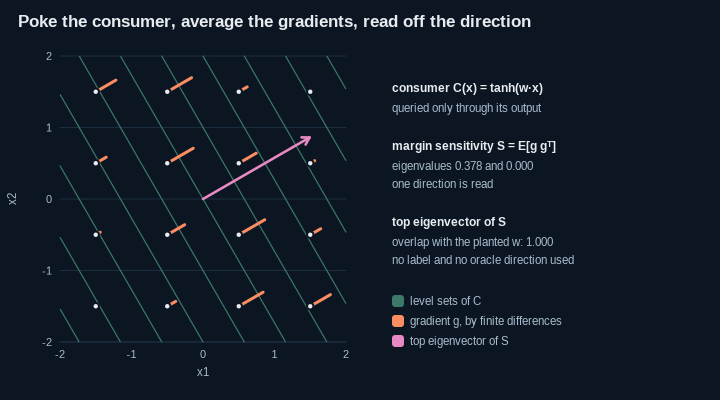
Figure 10.1. The probe worked on a planted consumer in a plane, C(x) = tanh(w·x) with w at 30 degrees. The thin lines are level sets of C. At sixteen operating points the gradient g is taken by finite differences of the output alone and drawn as a stroke. Every stroke points the same way, and where the consumer saturates the strokes shrink. The margin sensitivity S, the average of g gᵀ, has one nonzero eigenvalue, and its top eigenvector is the planted direction. This illustrates the mechanism and is not the GO-1 measurement.
What the probe can promise: GO-1
On planted read subspaces — where the truth is known and the probe is graded against it — the blind probe is decisive. It recovers the read subspace at overlap 0.936 vs 0.059 chance (≈16×), seeing only $C(\cdot)$; its blind projected-variance statistic predicts the flip 12/12 in both consumers, with Spearman 1.00 against the true subspace; and reconstruction cannot (0.40) [predicted — GO-P-2026-011, blinded, prospective, PASS 5/5]. The scope is stated: a planted low-rank read subspace with a tanh consumer; the real-model consumer is the hardening, and the rest of the chapter is that hardening.
The read operator also generalizes to a Hessian. In gradient compression against a curvature consumer, the projected variance $\operatorname{tr}(H \Sigma_\delta)/\operatorname{tr}(H\Sigma_0)$, computed from the planted curvature $H$, tracks the update distortion 12/12 at identical reconstruction, while reconstruction is uninformative (Spearman $-0.20$) [predicted — GO-P-2026-010, Gate B, PASS 5/5]. The read operator $P_C$ is not tied to classification; it is whatever the consumer’s second-order sensitivity is. (In that test $H$ was given, not probed; recovering a curvature operator blind is not yet on the record.)
The decisive test: a real consumer, recovered blind
Planted subspaces are a laboratory. The question that matters is whether the probe recovers a real consumer’s read operator — one that is both misaligned with the signal energy and generalizing to held-out data. The legal-retrieval sequence is the program’s cleanest answer, and it is worth telling in full because it is also a story about how the discipline distinguishes a failure of the flip from a failure of the instrument.
035 (miss). The first attempt estimated the read operator as the centered document covariance — a stand-in fit on calibration data. On the held-out set the recon-trade and anti-control passed, but the flip failed: reconstruction-optimal beat read-preserving (retrieval AUROC, O=0.773 > R=0.757) [refuted — GO-P-2026-035, a registered miss; the estimated subspace overfit and did not transfer]. A weaker program would have concluded the flip does not hold on real retrieval. The discipline’s diagnosis was sharper: this is a read-operator identifiability failure, not a failure of the flip — the covariance estimate captured what the signal varies in, not what the consumer reads.
036 (rehab, confirmed). The single fix: replace the estimated covariance with the GO-1 blind probe margin-sensitivity operator, kept low-rank ($r = 32$), with the config chosen on an internal cal-A/cal-B split and sealed before touching the held-out set. On the same held-out data the verdict flipped: R=0.779 > O=0.771, flip 200/200, recon O=0.220 ≪ R=0.584 (reconstruction-optimal reconstructs 2.6× better yet is downstream-worse) [predicted, hit — GO-P-2026-036, 4/4]. The blind probe recovered a read operator that was both misaligned-with-energy and generalizing — the two conditions the 035 negative proved necessary.
039 (fresh split). Because 036’s held-out set had already delivered the 035 verdict and its margin was thin ($\Delta = 0.008$), the frozen 036 recipe was re-run on a fully virgin opinion-disjoint split, blind probe refit. All four bars passed with double the margin (R=0.796 > O=0.780, $\Delta = 0.016$; R even edges the uncompressed baseline — nuisance-stripping denoises the ranking), flip 200/200 [predicted, hit — GO-P-2026-039]. The held-out-reuse asterisk was removed.
This is the first demonstration that the GO-1 blind probe, previously only [predicted] on planted subspaces, recovers a real consumer’s read operator with the two properties the theory needs. It is the chapter’s central result.
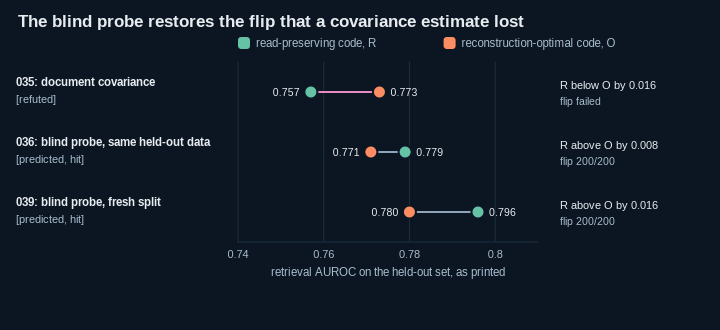
Figure 10.2. The three legal-retrieval tests, with the downstream scores printed in the text for the read-preserving code R and the reconstruction-optimal code O. In 035 the read operator was the document covariance and O beat R: the flip failed [refuted]. In 036 the operator came from the blind probe and, on the same held-out data, R beat O by 0.008 [predicted, hit: GO-P-2026-036, 4/4]. In 039 the frozen recipe on a fresh opinion-disjoint split gave R over O by 0.016 [predicted, hit: GO-P-2026-039]. The horizontal axis starts at 0.74, not at zero.
What the probe cannot promise
The probe is an instrument, and instruments have limits the ledger records at full prominence.
On a frontier attention head, blind recovery is real but was sub-bar (NEG-12). On
Llama-3.2-3B post-RoPE keys, the blind Jacobian probe recovered the read operator at
median overlap 0.567 — real, ≈4.5× chance, with strong heads at 0.815 and 0.958 — but missed
the sealed 0.60 bar, and because the registered quantizer pair was not
reconstruction-matched, proj_beats_recon could not fire [refuted — NEG-12]. Two of
three sealed triggers missed, bounding the theory to synthetic consumers on that
evidence. The corrected rematch (recon-matched key codes) then passed cleanly —
blind $\operatorname{tr}(\hat P\Sigma_\delta)$ predicts the worse arm 16/16, probe
overlap 0.647 ≥ 0.60 [predicted, hit — GO-P-2026-021] — but NEG-12 stands as its own
negative. The instrument works; the first sealed design for testing it on a real model
was flawed, and both facts are on the record.
Blind direction transfers; blind point-magnitude does not (yet). The most stringent test — recover $P_C$ non-oracle on a fresh untouched domain and commit the winning code and its magnitude before opening the test split — came back partial on 20 Newsgroups (041): the blind winning-code prediction passed (AUROC R=0.975 > O=0.910, the framework chose the better code before any label), but the two-metric flip tied on held-out and the point magnitude overshot its sealed band [refuted, as a full flip; mechanism confirmed]. The blind downstream direction is recoverable prospectively; the cross-domain magnitude scale constant is an open problem (Chapter 17). Across rates the magnitude tracks (Pearson 0.995, both decreasing per the finite-rate criterion); across domains the constant does not yet transfer. The book claims the direction and flags the magnitude.
Why blindness is the point
The probe’s blindness is not a limitation to be apologized for; it is the property that makes the theory deployable. If recovering $P_C$ required labels, an oracle, or the consumer’s source code, the framework would apply only where you already know everything. Because it requires only the ability to query the consumer and watch it respond, it applies to trained networks, third-party estimators, and physical instruments alike. You do not need to be given the observer. You need to be able to poke it. The next chapter turns the probe outward — from recovering an observer’s read metric to recovering the manifold a representation lives on.