Chapter 11 — The Recognizer: Naming a Manifold, or Certifying None
The blind probe recovers an observer’s read metric. The recognizer asks a dual question: given a representation, can we name the manifold it lies on — or certify that it lies on none? This is the instrument of the LEGIBILITY shadow turned into a procedure, and it carries one of the book’s most quotable findings: dimension emerges before shape.
The problem
A learned representation is a cloud of points in a high-dimensional space. Often we believe — or hope — that the cloud lies near a low-dimensional manifold: a circle, a sphere, a torus, a product of these. The recognizer’s job is to decide which, using only the representation’s own spectral geometry, and to refuse when the honest answer is “none of these.” Refusal is as important as recognition; an instrument that always names a manifold is a horoscope.
The mechanism: low multiplets and angular distances
The recognizer reads two things, and only two: the low eigen-multiplets of the representation’s Laplacian (the pattern of near-degenerate low eigenvalues) and the angular distances between points (the Keep-the-Angle coordinate of Chapter 9). Its read metric — for it, too, is a consumer with a read metric — has range spanned by these low modes and kernel on the high modes and on the density (which it discards exactly as the geodesic-rank consumer does).
Why these two? Because the low-multiplet structure is a fingerprint of the manifold. The eigenvalue multiplicities of the Laplacian on a symmetric space are dictated by its representation theory: the sphere $S^d$ has multiplicities counting spherical harmonics of each degree; a torus $T^d$ has its own lattice-counting pattern; a product manifold has the product structure. Read the low multiplets and you read the manifold’s symmetry class. The angular distances then fix the metric within that class. Together they name the manifold, or — when the multiplet pattern matches no candidate and the angular distances are inconsistent — certify that none fits.
Dimension emerges before shape
Here is the finding that gives the recognizer its character. By the Weyl law, the counting function of the Laplacian eigenvalues below a threshold grows like $N(\lambda) \sim C_d\, \lambda^{d/2}$, with the dimension $d$ in the exponent and the finer geometry only in the constant and the corrections. This means the eigenvalue ordering fixes $d$ before it fixes the shape: you can read how many dimensions a representation has from the growth rate of its spectrum, while the question of which $d$-manifold it is requires the finer multiplet structure that emerges later in the spectrum (the Weyl-ordering derivation, Paper I.5; not yet a ledger row).
The slogan “dimension emerges before shape” is not a metaphor. It is the statement that the map (representation) $\to$ (intrinsic dimension) is legible from a coarser spectral read than the map (representation) $\to$ (manifold identity). Operationally, the recognizer reports dimension with confidence well before it commits to a shape, and its staged output — dimension first, shape second — mirrors the mathematics rather than imposing a convenient UI on it.
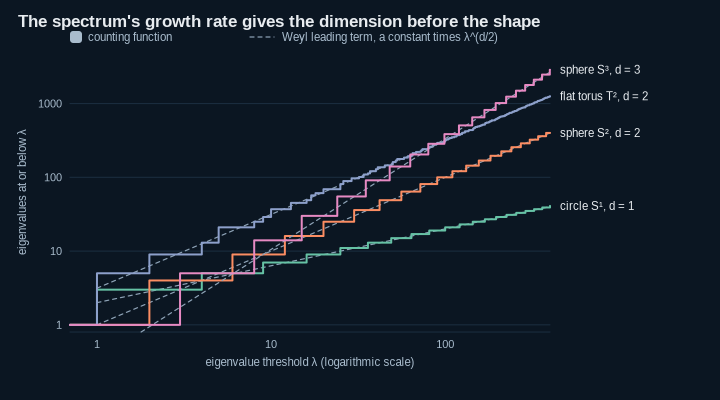
Figure 11.1. The Weyl law of the text on four spaces whose Laplacian spectra are known in closed form. The horizontal axis is the threshold λ and the vertical axis is the number of eigenvalues at or below it, both on logarithmic scales, so the slope of each staircase is d/2. The dashed lines are the Weyl leading terms. The sphere and the flat torus are both of dimension 2 and climb at the same slope. They differ in the constant and in the sizes of the steps, 1, 3, 5, 7 for the sphere and 1, 4, 4, 4 for the torus, which is the shape. This is an illustration from known spectra, not a measurement by the recognizer.
The certificate and its vacuity threshold (GO-3)
Recognition needs a stopping rule: at what point does the representation’s geometry become too degraded — by compression, by finite sampling, by the collapse of Chapter 3 — for single-stage recognition to work at all? The recognizer answers with a certificate whose vacuity threshold is derived, not fit: at $\rho = 1$ the certificate goes vacuous, and this predicted line locates where single-stage retrieval dies, at $\rho_{50} = 0.948$ (within 6%), with ordering Spearman 0.991, beating raw margin (0.873), across 14 corpora [demonstrated — GO-P-2026-014, 6/6 gated]. The transition is finite-width, as a real phase boundary should be. The scope is stated: exchangeable distractors; a low-rank refinement ($N_{\text{eff}}$) is future work. The certificate is what lets the recognizer certify none honestly — it does not merely fail to find a manifold, it produces a number saying the geometry is too vacuous for one to be found.
Recognizing emergent geometry
The recognizer’s most striking application is to substrates where geometry is not imposed but emerges — hypergraph-rewriting systems and similar generative substrates, where a discrete rewrite rule produces a growing structure whose large-scale geometry is an empirical question. The recognizer names the manifold such a substrate approximates, or certifies that it approximates none, and “dimension emerges before shape” appears here too: the substrate’s dimension stabilizes before its shape does as it grows. (A gotcha the program logged: the maximum generation must scale with the budget, or the substrate is read before its geometry has settled — a measurement artifact, not a property of the substrate.) No result of this application is recorded in this repository or in the ledger; it is reported here as the program’s account, not as a ledger row.
The recognizer as a consumer
It is worth closing the loop. The recognizer is not outside the framework looking in; it is a consumer with a read metric, and its read metric — low multiplets plus angular distances, discarding high modes and density — is one more row of the consumer table (Chapter 4). Its density-blindness is the same density-blindness as the geodesic-rank consumer’s; its reliance on the angle is the same Keep-the-Angle mechanism. This is the coherence the book keeps claiming: the instrument that names manifolds and the observer whose collapse started the program read the same coordinate and discard the same nuisance. The recognizer is legibility made into a tool, and the tool is built from the same operator as everything else.
With the probe (recover the observer) and the recognizer (recover the manifold) in hand, the last instrument is the one that says when the flip appears — the failure taxonomy and the alignment law that turns “know your consumer” into a measurable dial.