Chapter 18 — The Principle: Keep the Structure the Observer Can Use
This volume reduces its framework to a single sentence. The seventeen chapters before this one, their theorems, the twelve domains of the sweep, and the honest negatives of Chapter 16 reduce to five words:
Keep the structure the observer can use.
The rest of this chapter says what those five words license, what they do not, and why the framework they name is best understood as one theory — a consumer-relative rate–distortion theory, a quantized Shannon — of which classical information theory is a single slice.
The one object, restated
The whole book has been about one operator. Fix an observer $O = (C, G, B)$ and it induces the read metric $P_C = J^\top G J$: the geometry of what that observer can distinguish. Everything else is a shadow of this operator.
- Its rate–distortion function $R_C(D)$ is what the observer charges — the COST.
- Preserving it beats reconstructing the object — the flip, the VALUE.
- Its quotient $X/\!\sim_C$ reveals the structure the observer acts on, sometimes more legibly than the original — the LEGIBILITY.
- And it is identifiable from the observer’s behavior alone — the blind probe, which is what makes the other three usable rather than theoretical.
Cost, value, legibility, identifiability: four faces, one operator. The intellectual claim of the book is that these were four literatures — rate–distortion theory, task-aware compression, spectral embedding, and probing — and that they are one theory, whose single object is the pullback of the consumer’s output metric.
Quantized Shannon
Here is the framing I find most clarifying. Shannon’s rate–distortion theory prices the faithful reproduction of a source. It is exactly recovered by this framework in the slice $P_C = I$ — the observer that reads every direction equally, whose quotient is trivial, whose flip collapses (reconstruction is optimal when $P_C = I$), and whose legibility is vacuous (nothing is quotiented away). Classical information theory is the $P_C = I$ face of a consumer-relative theory.
Turn $P_C$ away from the identity — give the observer a genuine read subspace and a genuine kernel — and the four faces separate and come alive: the rate tilts, the flip appears, the quotient reveals, the probe has something to recover. The framework is Shannon’s theory with the fidelity measure promoted from a fixed constant to the observer-dependent variable it always was. “Quantized” is the right word twice over: the theory is about quantization (lossy codes at a budget), and it quantizes Shannon in the sense of resolving a continuous idealization (perfect reproduction) into observer-relative parts (what this consumer, at this budget, can use). The consumer- relative rate–distortion thesis is the spine, and Shannon is the $P_C = I$ vertebra.
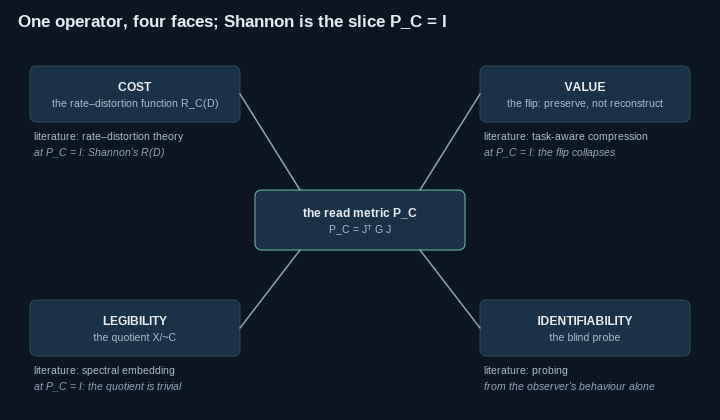
Figure 18.1. A schematic of the chapter’s summary: one operator, four faces. Each face is a shadow of the read metric P_C, and each was a separate literature, named beneath its box. The last line under three of the faces says what happens in the slice P_C = I, the observer that reads every direction equally: the rate is Shannon’s, the flip collapses because reconstruction is then optimal, and the quotient is trivial.
What the principle licenses
“Keep the structure the observer can use” licenses a definite change in practice.
It says: do not measure a code by its reconstruction error unless your observer is isotropic. Measure it by the read distortion $\operatorname{tr}(P_C\Sigma_\delta)$, and when you cannot write $P_C$ down, recover it with the blind probe. It says: the worse-reconstructing code can be the right code, on purpose, and you can judge in advance whether it will be, by measuring the alignment $\kappa$ (an ordering with an exact null, not a law of the flip’s size) and placing your domain on the two-axis regime map (an exploratory diagnostic, not yet a ledger row; Chapter 12). It says: adapt, do not universalize — no single code wins across regimes, and the domain-dependence of the flip is the reason an adaptive selector, not a universal codec, is the correct engineering object. And it says, in the LEGIBILITY register: when a representation looks degenerate, ask which observer’s kernel is doing the degrading — the geometry may have moved into a coordinate you were not reading, as it did into the angle.
These are not slogans; each is cashed out in a chapter and carries ledger rows at its class bar.
What the principle does not license
The discipline of the book is in its boundaries, and the principle inherits them.
It does not license discarding reconstruction everywhere. When $P_C \approx I$ the slice is where you live and the classical tools are correct; the framework’s claim is that this is a case, not the whole, not that it is wrong.
It does not license the flip where the read operator is coupled to the signal energy ($\kappa \to 1$, the D4 boundary), absent (no working consumer, the moral-on- frozen-embeddings precondition), or mechanism-free (the $\alpha = 1$ density quotient outside diffusion, NEG-11). Three of these are diagnosable before you run; one is a hard wall. The principle applies where the read operator is identifiable and misaligned with the signal, and nowhere is that clause optional.
It does not license a point prediction of the flip’s magnitude across domains — that constant is open (Chapter 17). The framework says which code wins and, within a domain across rates, by roughly how much; the portable magnitude is not yet in hand, and the book does not pretend otherwise.
And it does not license asserting anything the ledger cannot show. That is the house rule, and it is the reason every claim in this book wears a tag and every miss is printed beside its win.
The register the book was written in
I began with a footnote about an angle and ended with a principle about observers, and I want to close on why the arc mattered. The angle was not special; it was the first case in which the program saw that a representation’s apparent degeneracy was really one observer’s blindness, and that a different observer read the surviving structure fine. Everything after — the read metric, the flip, the rate–distortion theory, the probe — was the generalization of that single reversal of perspective: stop asking what an object is and start asking what an observer can use, and the questions that were ill-posed become answerable, one observer at a time.
Keep the structure the observer can use. It is the whole of the theory, and it is the name of the next thing to build.
— end of Part VII —