Chapter 19 — The Certificate That Ages
Part VIII — RELIABILITY: The Witnessed Certificate. This is the reading the title promised and the earlier chapters set aside. Parts III–IV asked what an observer reads and what it may discard. This Part asks a question that only appears once time is in the picture: is what the observer reads still true?
Maya’s cache returns in a second guise. In the Preface it discarded the structure its consumer needed — the allocation failure, $\operatorname{tr}(P_C\Sigma_\delta)$ read as distortion. But a cache has a second, quieter way to be wrong: it can return an answer that was right and no longer is. The entry is well-chosen; it is simply stale. No amount of the earlier theory sees this failure, because the earlier theory has no clock.
Three kinds of change should be kept apart. A changing source — statistics that drift, cycle, grow, or vary without a period — is the subject of the RLD series (Chapter 7), which holds the consumer’s weight and the holder’s map fixed and asks what the description costs. A drifting observer — a read operator that changes, so that a description tuned to yesterday’s consumer misreads today’s — and a reliable monitor — a certificate whose claims are witnessed and whose false-clear rate is calibrated — are this Part’s subjects, and they need assumptions and results of their own. The coding theorems supply limits and benchmarks for expected distortion; a monitor’s false-clear rate is a further statistical claim, which needs its own argument and its own measurement.
The certificate
Almost every operational decision rests not on a measurement but on a certificate — a claim, issued at some time $t$, that a read is within tolerance:
the medium is idle · the replica is fresh enough · this rate is supportable · the device is calibrated · the network has converged · the line is within its limit.
Each licenses an action (transmit, serve the read, pick the modulation, dispatch) intended to satisfy a target. And each is a claim about the observer’s read at a time — evaluated, like everything in this book, through the consumer’s read operator $P_C$, not through an aggregate.
A certificate ages. The state it certifies decorrelates over a characteristic coherence time $T_{\mathrm{coh}}$; a certificate issued at $t$ and acted on at $t+\Delta$ can be wrong for no reason other than $\Delta$. The static theory of Part II is the $\Delta = 0$ slice — and just as $P_C = I$ was reconstruction masquerading as a universal (Ch. 2), $\Delta = 0$ is instantaneous certainty masquerading as the normal case. It almost never is.
The witnessed triple
Freshness needs three objects, and the discipline — as always in this book — is in taking each literally.
The certificate $\mathcal{C}_t$: the asserted-safe read at time $t$, a claim of the form “$P_C$-read is within tolerance.”
The witness $W$: an independent measurement of the true outcome, native to the substrate. The book’s insistence on a witness is the freshness form of its insistence on a consumer — a claim you cannot grade is not a claim. The witnesses are already deployed, and that is the point:
| Domain | Certificate | Witness |
|---|---|---|
| routing | quiescence (silence) | a dataplane probe / monitor feed |
| replication | replica-lag bound | the WAL LSN / oplog ts / zxid |
| cellular | CQI / CSI report | the HARQ ACK-NACK |
| optical | QoT (GSNR) estimate | the pre-FEC BER |
| power grid | “within limits” state estimate | the true AC power flow |
| quantum | device calibration | randomized / mirror benchmarking |
The refresh floor $\phi$: the maximum renewal interval that keeps the certificate honest. It is not a convention; it depends on how fast the certified state decorrelates, and Chapter 21 records what has been measured of it.
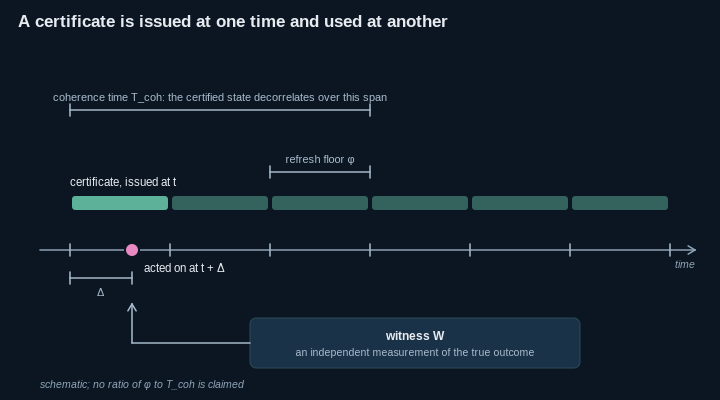
Figure 19.1. A schematic of the witnessed triple on a time axis. Each bar is one certificate, a claim that the consumer’s read is within tolerance, valid from its issue until it is renewed. The certificate issued at t is acted on at t + Δ, and it can be wrong for no reason other than Δ. The witness is an independent measurement of the true outcome, and it grades the claim at the time of use. The renewal interval is the refresh floor φ, drawn shorter than the coherence time. The ratio is schematic: Chapter 21 reports that the proportionality law once fitted between them is refuted, and that no constant survived the sealed rerun.
The false-clear rate
The one number this Part is built on:
$$ \boxed{\,\mathrm{FC} \;=\; \Pr\big[\,W \text{ refutes it} \;\big|\; \mathcal{C}_t \text{ clears}\,\big]\,}, \qquad \text{coverage} \;=\; \Pr\big[\,\mathcal{C}_t \text{ clears}\,\big] $$
— the rate at which a clearance is wrong, conditional on the certificate having cleared, reported beside the certificate’s coverage. (An earlier draft wrote the joint probability $\Pr[\text{clears} \wedge \text{refutes}]$; the joint rate is the product of the two and is what a naive certificate that clears everything reports, since its coverage is one. Corrected 2026-09-03.) A certificate whose false-clear rate exceeds the target it purports to guarantee is vacuous for that consumer, however confident it looks. FC is measurable wherever a witness exists, which — per the table — is nearly everywhere it matters.
Two properties make FC the right object, and both are inherited directly from the allocation theory.
It is consumer-relative. FC is a property of $P_C$, not of the certificate in the abstract. On a single ZooKeeper follower at a single instant, a client reading a hot footprint is 99% stale while a client reading a cold footprint on the same replica is 1% stale — a $99\times$ difference produced entirely by what the consumer reads [replicated]. There is no single “the replica is fresh enough” that serves both; the aggregate lag bound is the $P_C = I$ error again, wearing a clock.
It answers a $\operatorname{tr}(P_C\Sigma)$ question. Where allocation reads $\operatorname{tr}(P_C\Sigma_\delta)$ as the distortion a code inflicts, freshness reads it as the distortion time inflicts: $\Sigma_\delta$ is now the second moment of the drift between issue and use, and $\operatorname{tr}(P_C\Sigma_\delta)$ is the consumer-felt error of acting on a stale read. Same operator; the clock supplies $\Sigma$. This is why freshness is a face of the theory and not an appendix to it.
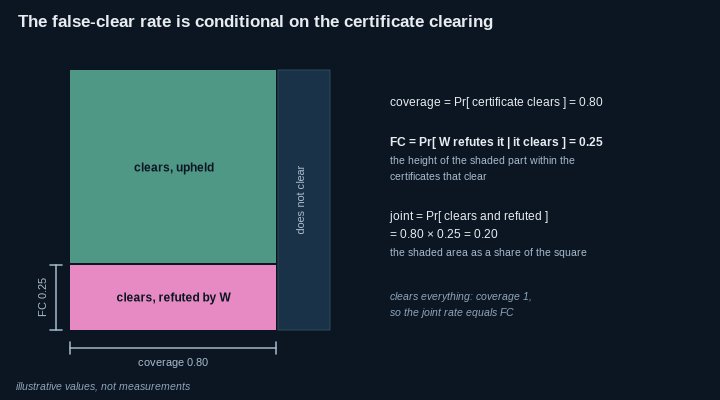
Figure 19.2. The false-clear rate as a conditional, drawn for illustrative values (coverage 0.80, false-clear rate 0.25; these are not measurements). The square is all certificates. Its width splits them into those that clear and those that do not. Within the ones that clear, the shaded part is the fraction the witness refutes: that fraction is FC. The joint probability of clearing and being refuted is the product, 0.20. A certificate that clears everything has coverage 1, so for it the joint rate and FC are the same number.
What this Part shows
The remaining chapters make the triple operational and then earn it across domains.
- Ch. 20 develops FC as a first-class KPI and the stark consumer-relativity of staleness — the vacuity of the aggregate certificate.
- Ch. 21 takes up the refresh floor. On a real 5G physical layer an unsealed exploration fitted the usable report period as linear in coherence time (slope $\approx 0.177$, $R^2 \approx 0.92$). Its source now records that fit as refuted: the floors were measured at a relaxed 0.15 threshold against a 0.10 budget, and the sealed rerun at the 0.10 budget finds a horizon of a few TTI at 10 Hz and one TTI at 50 Hz and above, with no proportionality law to fit. Separately, the optimal linear predictor cannot extend the horizon past one coherence time [exploratory] — a wall, not a knob.
- Ch. 22 runs the freshness sweep: the same witnessed-certificate grammar, measured across routing, replication and coordination, cellular PHY/RAN, and — as breadth — optical, power-grid, market, quantum, and AI-evaluation substrates. The umbrella rests on the sealed rows; the rest are carried at their honest class, and the one clean negative (sensor calibration) is kept at full prominence in the Ch. 16 tradition.
- Ch. 23 gives the instrument: the governor, which observes certificate and witness streams, measures FC per consumer, refreshes at the floor, and escalates to a mechanism change when refreshing cannot close the loop.
The principle the Part converges on is the temporal completion of the book’s sentence. Keep the structure the observer can use — and, because use happens in time, keep it current, and grade the claim that it is.