Chapter 20 — The False-Clear Rate
STUB [A] — draftable now. Source:
observation-theory-campaignsfreshness cells +FRESHNESS-PROGRAM.md; ZK cell (analysis/zk,ZK-USE-CASES.ipynb); routing D8 (analysis/xproto,analysis/d8). House voice per Ch. 19. Every number is to resolve to aSEALS.mdrow; neither Appendix D nor Appendix F, norclaims/LEDGER.md, carries these rows yet.
What this chapter must establish
- FC as a first-class KPI, not a derived afterthought: define, measure, report
per
(certificate, consumer). Contrast with the conventions it replaces (a lag bound, a convergence timer, a confidence interval) whose error rate is never itself reported. - Vacuity: a certificate whose FC exceeds its own target is vacuous for that consumer. The routing anchor — 60 s quiescence false at 0.351 (BGP) / 0.184 (IS-IS) / 0.083 (OSPF) [replicated] — opacity orders the bands, implementation places within band.
- Consumer-relativity, made unavoidable: the ZK hot/cold 99× on one replica at one instant [replicated]; the database footprint certificate (~0.5 aggregate → ~0.02–0.06 per footprint) [replicated]. The aggregate certificate is the $P_C=I$ error with a clock (tie back to Ch. 2).
- The two-sided cost: false-clear (danger) vs false-refresh (waste); the
certificate interpolates between free-and-wrong and correct-but-costly (the ZK
read_freshcurve).
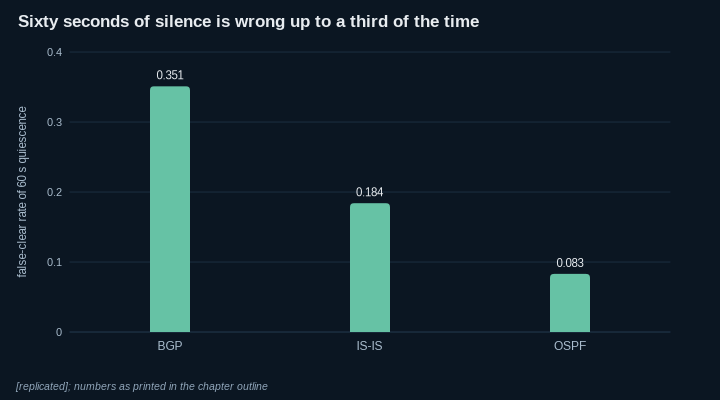
Figure 20.1. The routing anchor of the outline: how often the certificate “60 seconds of quiescence means converged” is false, for three routing protocols [replicated]. The vertical axis is the false-clear rate. The outline’s reading is that opacity orders the bands and the implementation places a system within its band. The outline prints no target for these certificates, so none is drawn.
Key figures / claims (→ ledger)
- FC definition box (from Ch. 19).
- Routing vacuity bar (three protocols) [replicated].
- ZK hot-vs-cold same-replica plot [replicated].
- DB aggregate-vs-footprint table [replicated].
Boundary
FC needs a sound witness; where none exists the claim is inference, not certification (forward-ref Ch. 23 + the skeptic’s appendix).